Kate Mosher Hall: Picture as Topography, Image as Scar
|QINGYUAN DENG
Kate Mosher Hall’s second solo show at Miguel Abreu Gallery spans a violent territory.
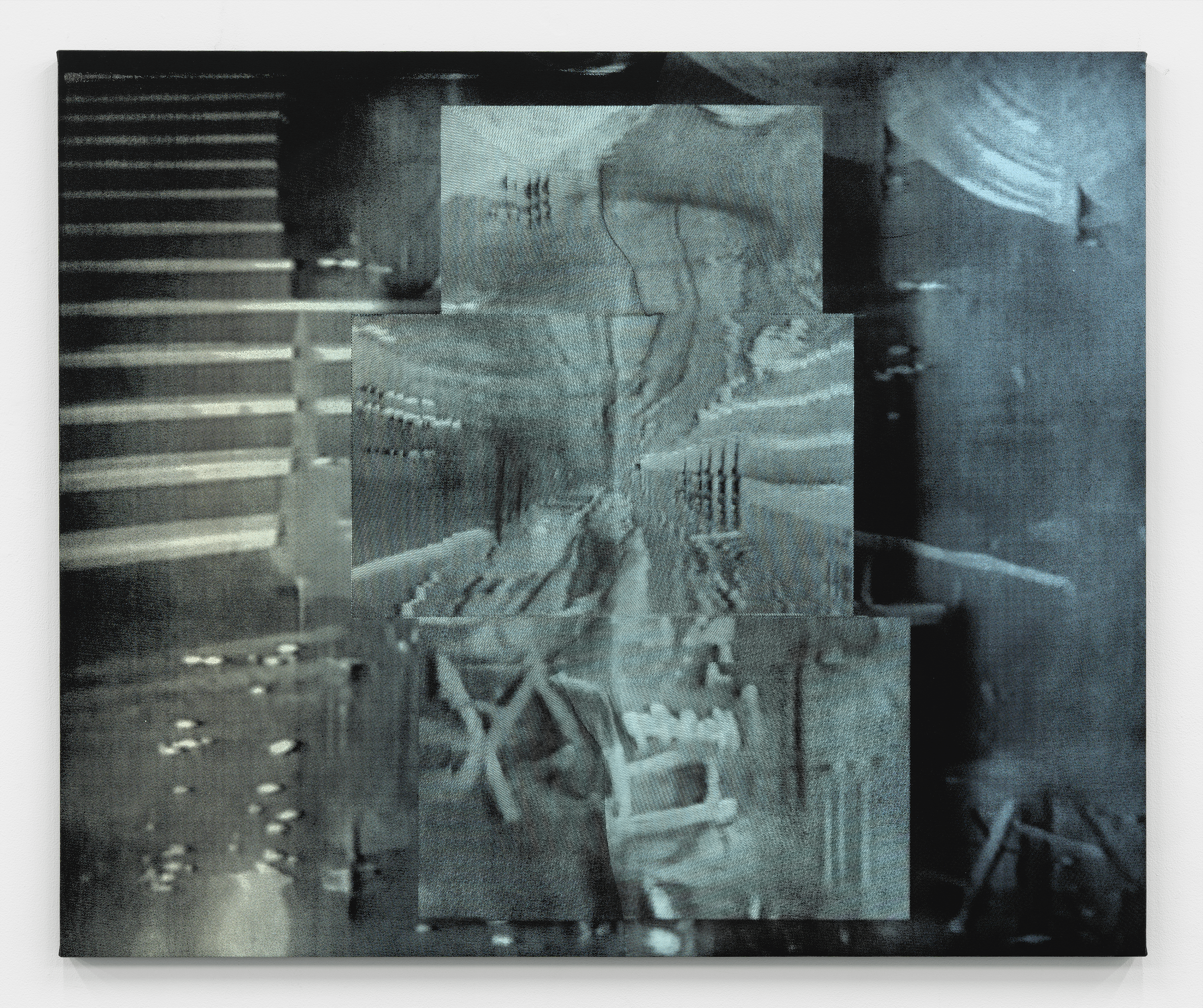
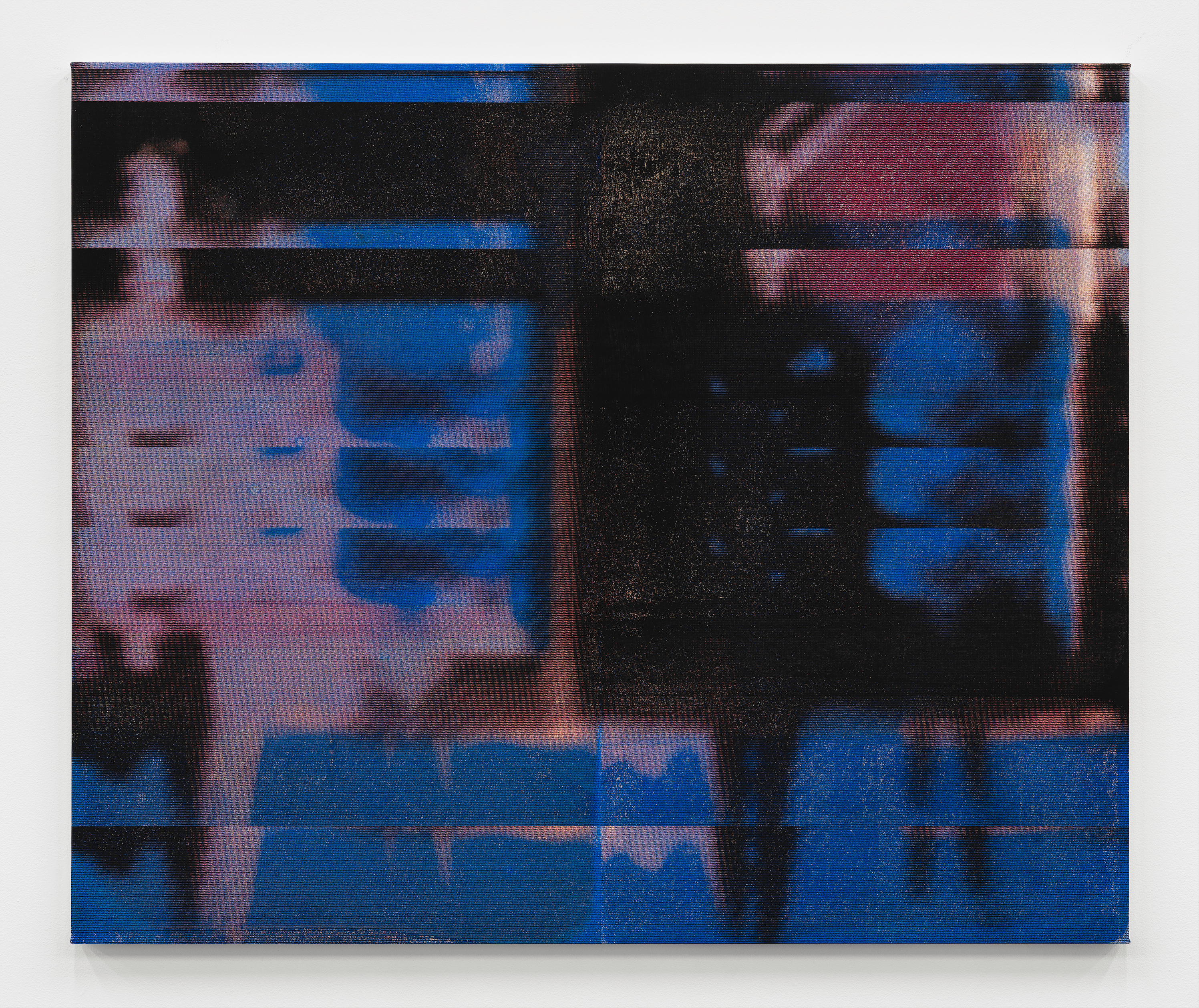
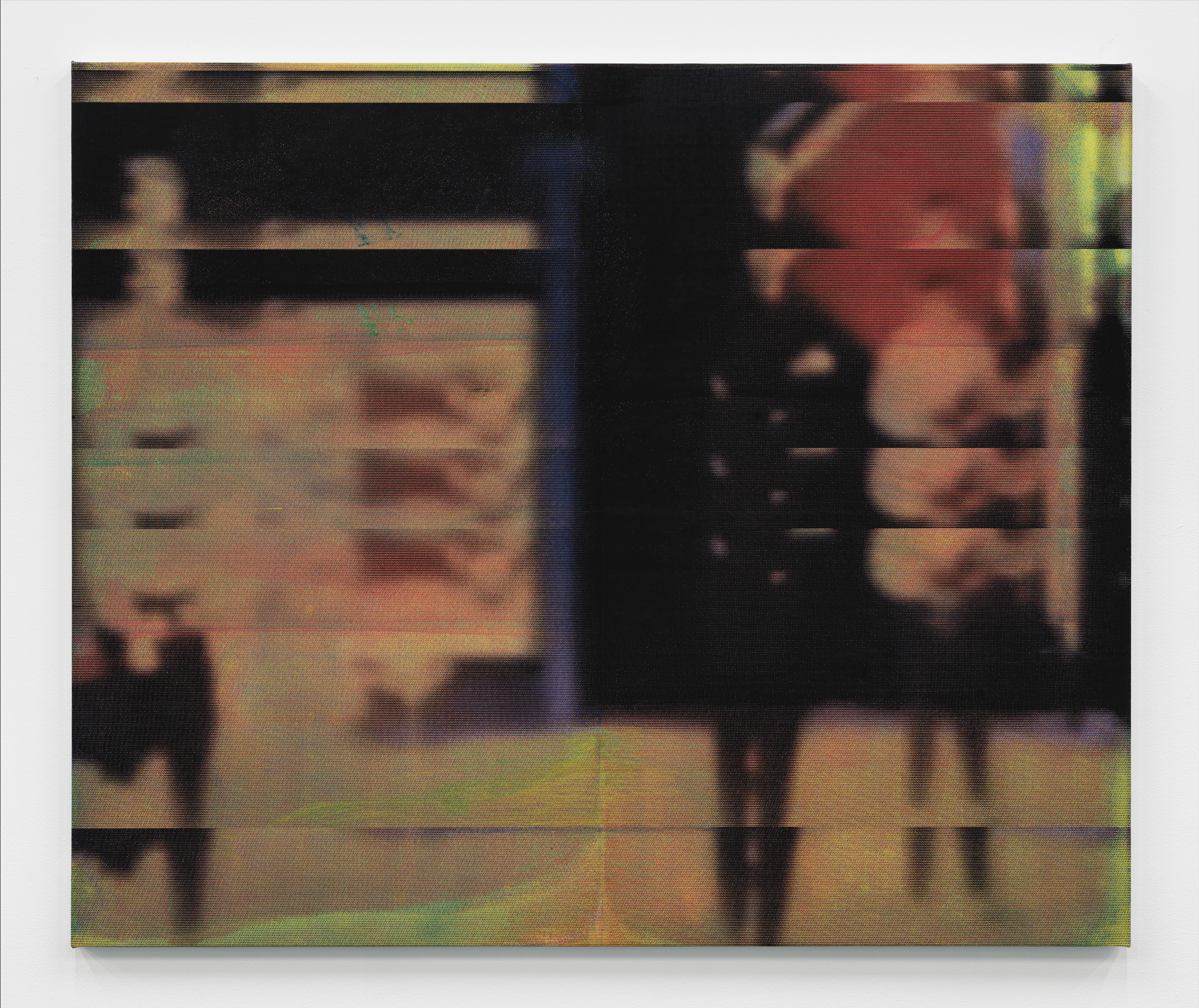
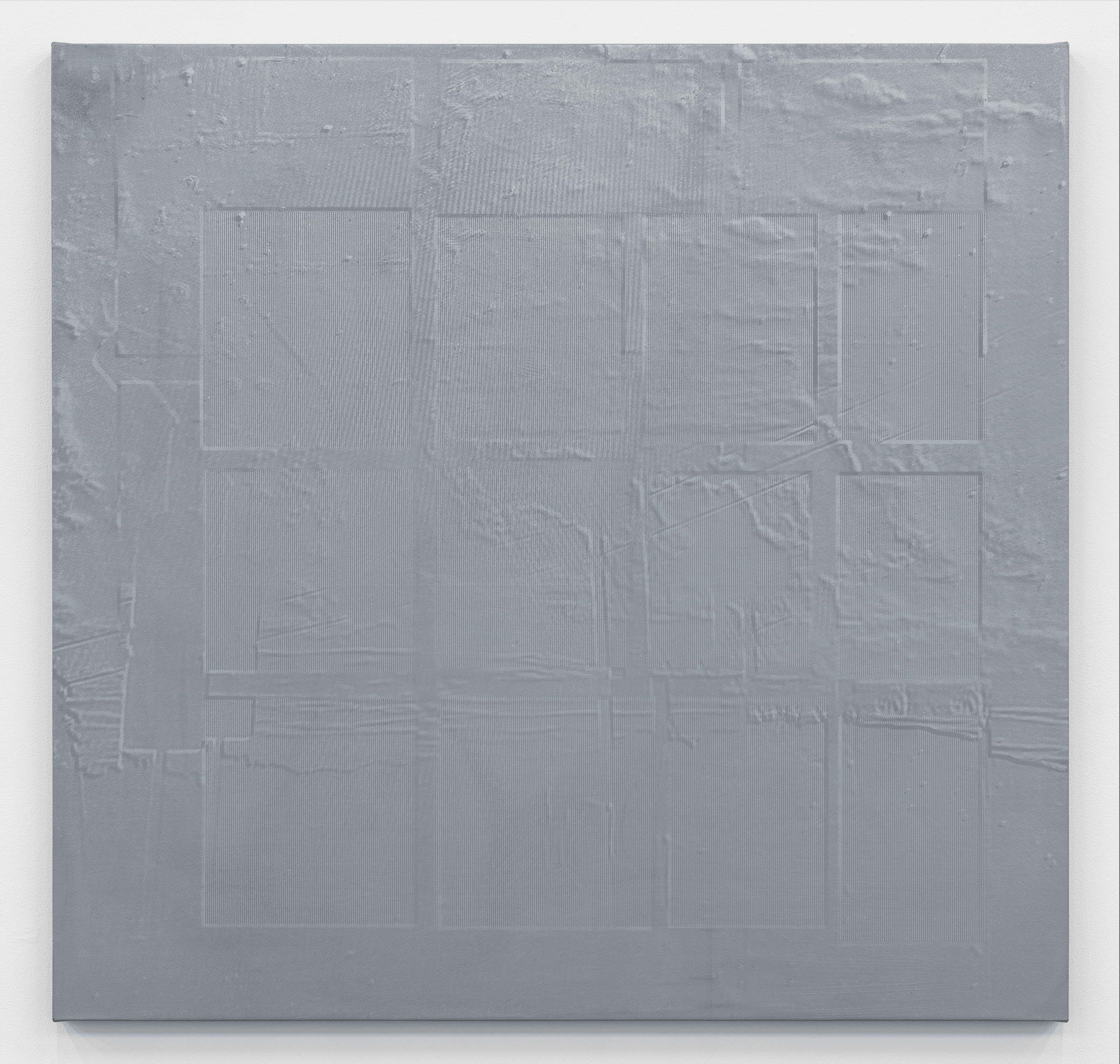
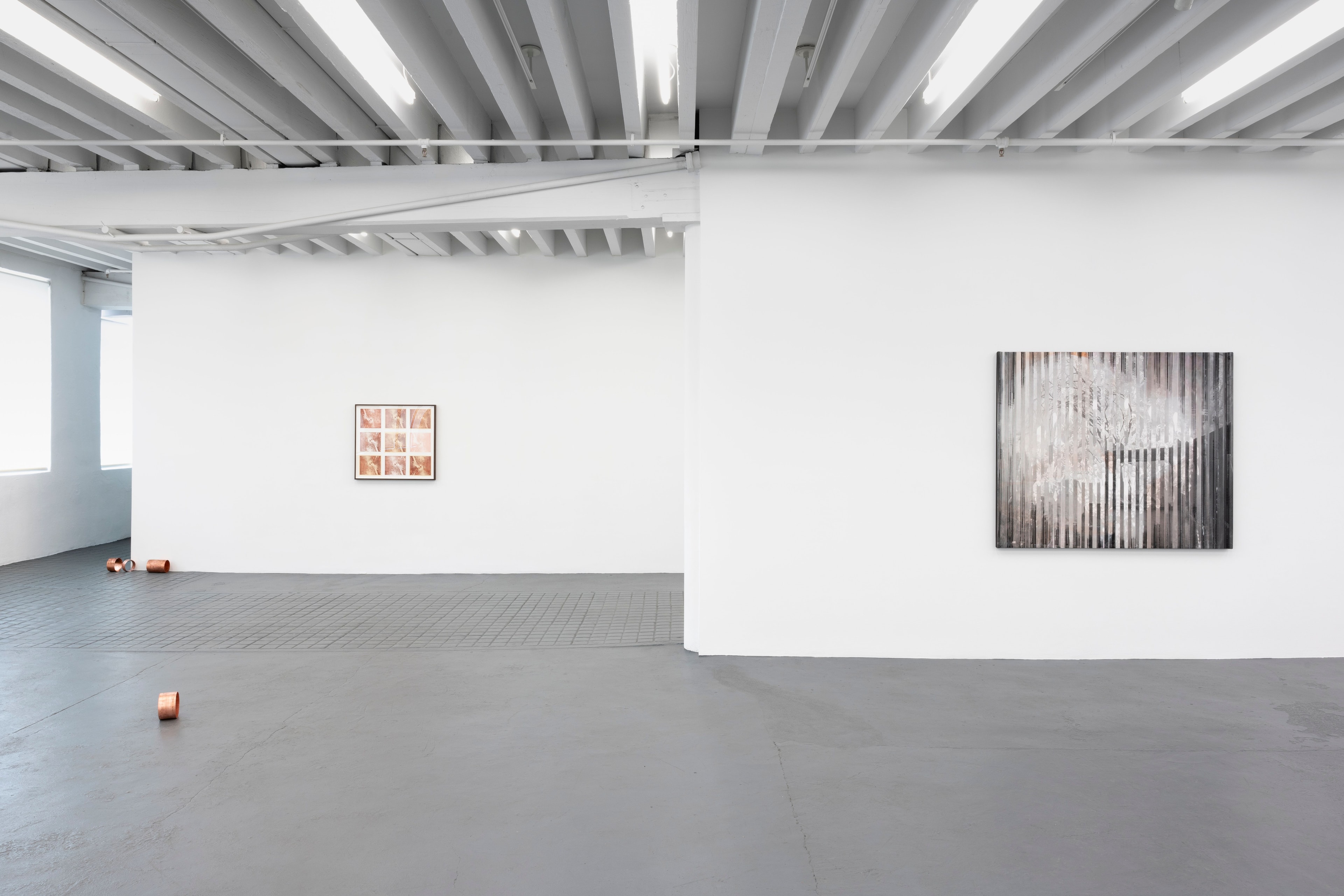
At one pole, The Ripple (2026) and The Rip (2026) read as corrupted CRT (cathode ray tube) signals. Magenta, blue, and chartreuse scanlines interlace, color diffusing the canvas like a social media feed dropping out from the screen. They are the most emphatically digital pieces in the room. At the other pole, New Music (2026) and Side to side (2026), which are near-monochrome gray paintings where the image emerges as an embossed relief in the surface of the paint itself, implores you to look at the canvas almost edgewise to register that anything is there. Both sets of paintings enact picture as topography, image as scar.
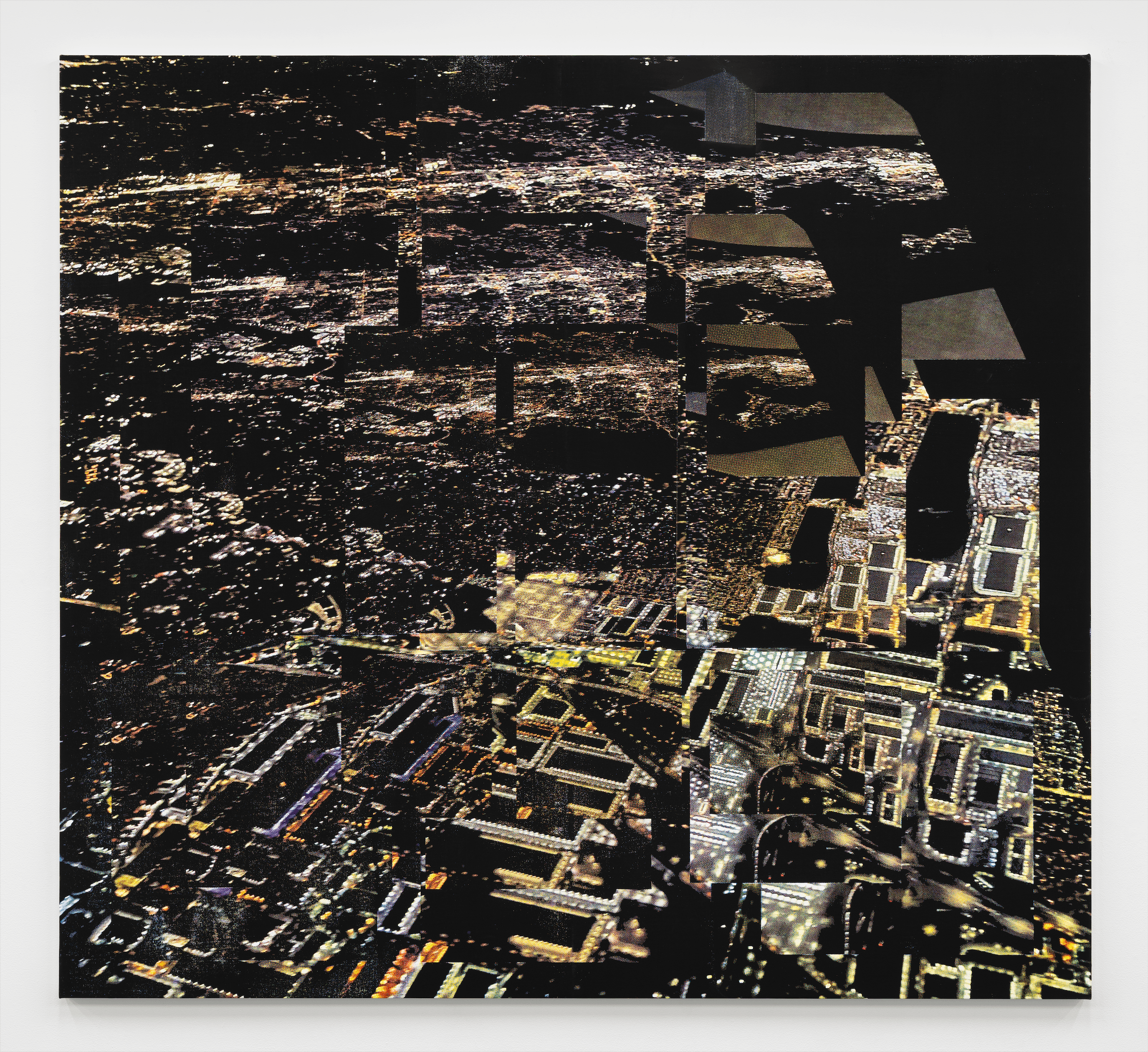
There is also Air (2026), one of the largest paintings in the show, which features a photograph of Los Angeles taken during a night flight descent, tiled back onto itself, the fragments of the same view rotated and overlaid until the illuminated grid of streets and freeways breaks open along the dark angular seams where one screen layer cuts into another. The coherent god’s-eye view splits along matte olive-gray planes, redacted and incised. Blacked-out zones recall the no-data gap of the satellite composite. The ground multiplies and shakes until no stable horizon survives: pure vertigo. This is not the sublime aerial expanse. It is the body of the land re-cut, made of scars.
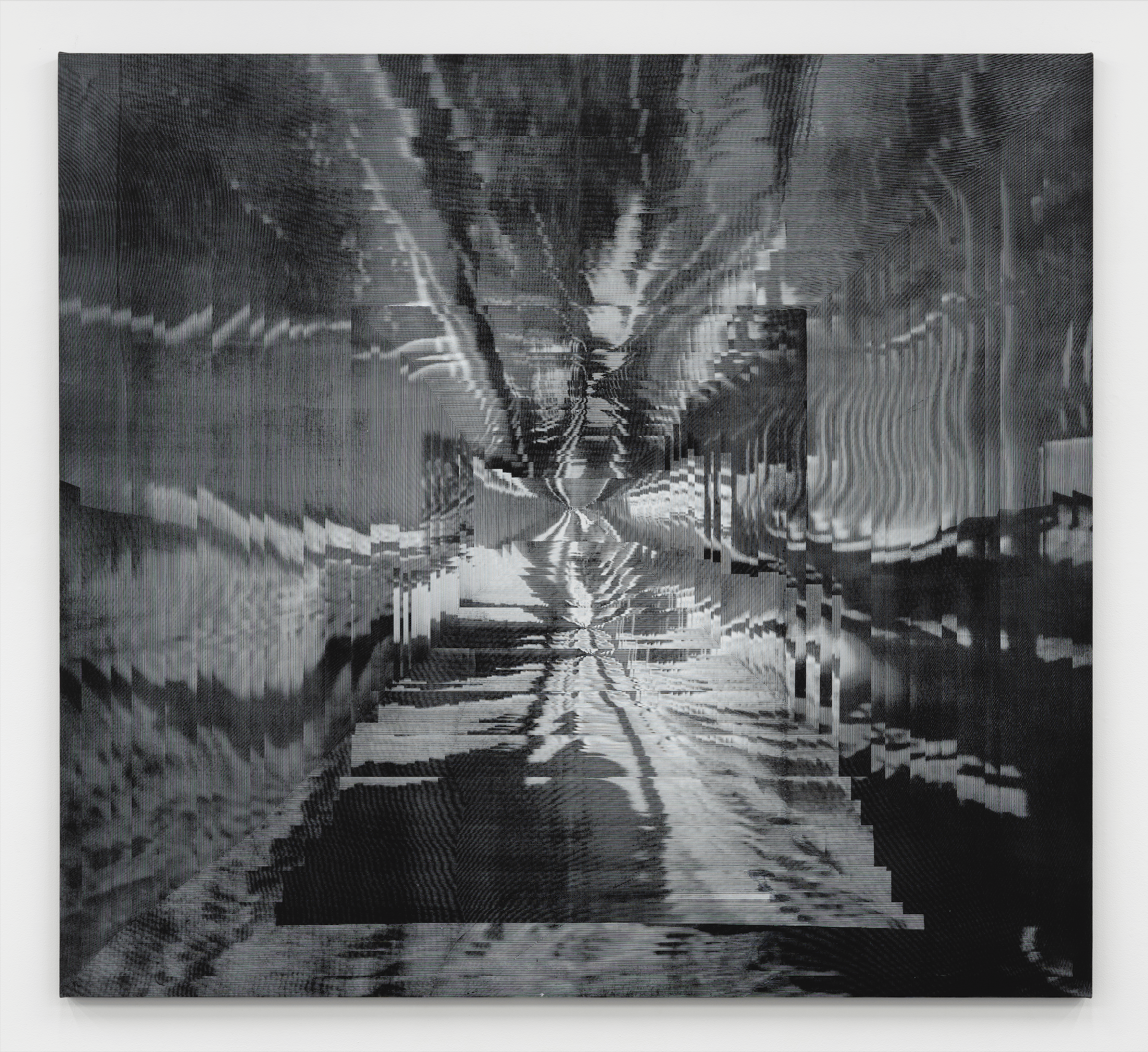
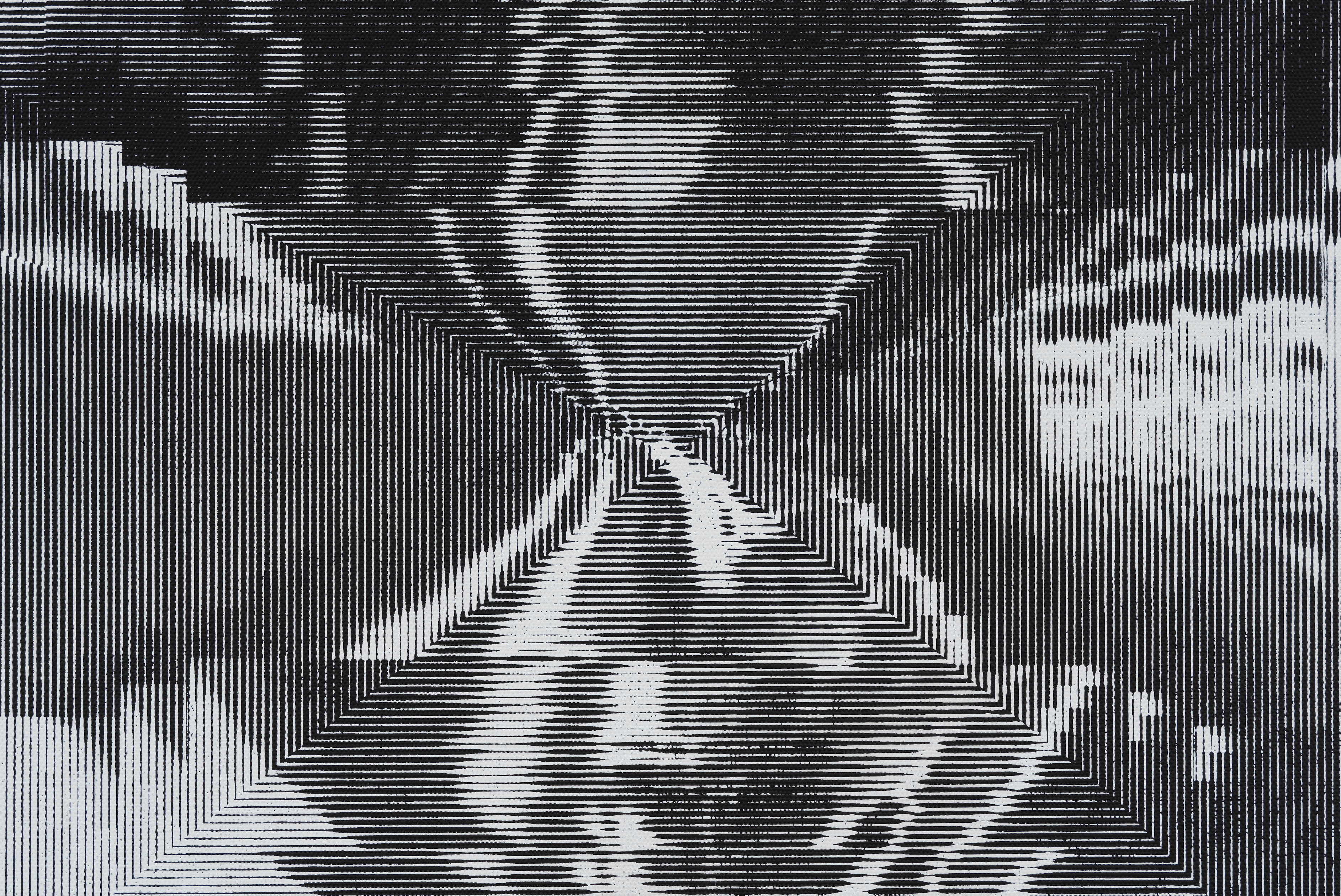
Even 1440 Degrees (2026) and 15-17 mph (2026), both black-and-white perspectival hallucinations with strong vanishing points, push the show toward Op art before pulling it back into the high-gain grain of low-light CCTV.
The show’s title, “Blast Beat,” is a drummer’s term lifted from hardcore punk and grindcore. Referring to a single stroke alternated between kick and snare at the edge of what the hand can sustain, fast enough that the individual beats dissolve into one undifferentiated roar, blast beat could also mean Hall’s velocity of image production here: pushing the countable image past its threshold until pixel thickens into compounded surface. We spoke shortly after the opening about the afterlife of punk and the digital death drive.
Qingyuan Deng: The title feels like a structural metaphor for the show. “Blast beat” is a metal term, [for a] a very dense grid of notes with a distinct tonal register. And there’s the metaphor of halftone, of resolving and dissolving. There’s the connection between silkscreen as a technique and that music metaphor. Maybe we can start there.
Kate Mosher Hall: I have a music background, and with drumming there was a lot of being in the grid. Then I was thinking about other expressions to be had outside of the grid, how the registration of speed and force perceived through a blast beat works, the quantity of hits. What does that make? There’s this feeling of intensity, of overwhelm, some sort of reaction that’s around heaviness or affect—an emotional thing. So it’s something around taking the grid and how it becomes another cadence or relationship based off the change of time.
QD: There’s also the connection to cinema in the show. I was thinking about the Ken Jacobs work (Other Urban Lives, 2023)—that constant flickering, the idea of making cinema almost sculptural. How do you see your painting in relation to cinema?
KMH: I’m actually more familiar with Thom Andersen, who is a collaborator and peer of Ken’s. I took his film history courses as an undergrad, and my relationship to cinema started there, working in black and white, in this way of structuring a scene very specifically. That director’s point of view, that hierarchy of space, the way of building light and darkness even within the field of a painting to construct and think about narrative—a lot of that came from studying early cinema, and the strategies of early cinema.
What is on or left behind, the mystery or allure, the way you build up anticipation—those are still early strategies that carry over into the newer work. We have such a relationship to repetition and touch through image consumption. It’s a conditioning that happens in our minds, but it can also become overwhelming. Having it be in stasis, still as a painting, allows you to sit with the idea of quantity in this other way.
QD: There’s a question of analog here too, because halftone is associated with early mass media such as photography and newspapers. You’re almost using halftone to not communicate so clearly. You’re interested in those stressors of accumulation, of layering, almost reversing the function of halftone, alienating it. How do you think about your painting in relation to those analog technologies?
KMH: I got into printmaking because of the music background, and it was a practice based in community, like having an open studio. Through time I became really invested in this process. Then I asked myself why I am doing silk-screening. I realized it’s how I’m navigating images at the scale that I am, and I can’t really imagine using something else. If I just printed it out, there’s a lot of intersections where the process inserts itself into—it’s all associated with a grid and a system that refers to itself.
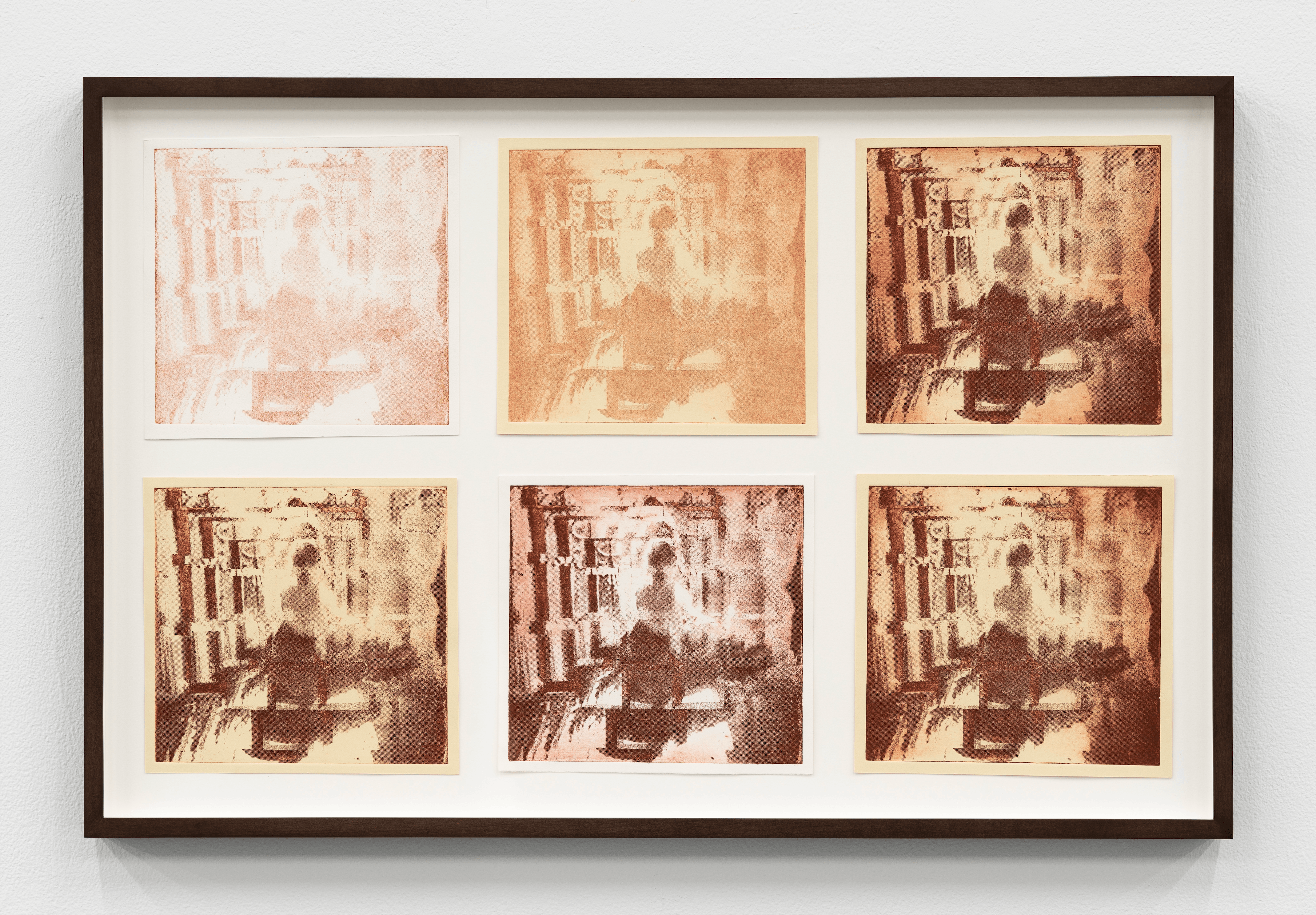
Halftone is binary, so when you’re burning the screens you’re making an image, and there’s a problem-solving [element] of having something be on or off. That’s where you see a lot of the work being black and white, because I’m able to build constructions in this rudimentary way of making images. There’s something I enjoy around the mechanics of it [the halftone]—it sets the analog materially, accentuates that on-off system.
QD: That brings the punk question in, because there’s a huge connection between screen printing and the subculture around punk. Do you feel emotionally tied to that subculture, and does that attitude carry into the paintings themselves?
KMH: There might be some aesthetic there. I try not to be too rigid because I’m a Virgo, so it’s second nature to be a perfectionist—and what I learned through punk was not to be that way. Technically the paintings are really complicated and specific to a recipe I’ve put together.
But punk, I think, doesn’t really exist anymore. It’s carried over into a totally different aesthetic now. If it’s cool to not be cool, how does punk relate to coolness anymore? It’s almost more like an ideology now: community or pretending not to be invested in capitalism. If I asked what’s still punk about me, it’d be that my foundation was that idea of punk and community. Collaboration, community efforts, politics—they are still present. But as a subculture? I don’t know if it really does exist.
QD: There’s that quality of punk where you push your body to the edges to let the intensity of the rhythm really penetrate. Painting at this scale, with so much attention to the grid, feels like a very intense practice, too. Do you feel they are connected, drumming and painting?
KMH: When I did the performance at the opening recently, a lot of people said the sonic relationship gave them a whole other access point to the work. It’s essentially the same thing—taking a grid and manipulating it to have these different registrations or repetitions, and asking how that builds space.
How do we sonically build space? Slide guitar creates this feeling of liminality, because the notes exist between notes. If we think of A, B, C, D, and how we construct music through these specific demarcations, we’ve taken a whole spectrum and reduced it to a few notes—but so many notes exist between those notes. If you can articulate that through the way we hear things, it’s interesting how the form leads the construct.
QD: Your paintings reward slow looking. There’s the temporal experience of looking for a long time, very closely, and also the experience of looking from a distance and then very close. How do you think about your surfaces, or how flatness is productive in your painting?
KMH: It’s a little bit of a strategy. There’s an optical illusion happening in the work—these things evoke a phenomenological experience when you’re seeing them. The way it falls apart in flatness when you go see it, and then come away from it, is a kind of choreography. That act of looking accentuates its difference from the phone, its difference from the screen—it speeds up those things, but it’s all those things too.
It also has to do with seeing the paintings in person versus seeing them photographed. Because of the different resolutions of how they’re constructed, when they’re photographed it compresses everything, so you’re only experiencing what the painting looks like from far away. Seeing it in person, you understand the construction, and there’s another reveal that happens at that lower resolution. It’s almost impossible to articulate that through photography. There’s something about having to see them in person.
QD: There’s a lot of mathematical precision in your work, especially with the use of the grid, but you also allow for improvization, drift, accidents. To me they feel like productive error and misregistration. Do you sabotage anything when you make something, or do you just let it happen?
KMH: It varies. There’s a real goal to have some sort of illusion happen, an intention with light, where at a certain distance I really want this thing to be seen in a certain way. If that doesn’t happen, I’ll change it, fix it, redo it, cover it up. But other times, absolutely. There’s letting the material have its own course. The process can do its own thing, because we’re in a feedback loop when you’re making. I’m the architect of this thing, but then it’ll do something, and it’s really exciting to bear witness—being alive, it’s cool—and then I make a decision with that, in collaboration with it, rather than wanting to be the full authority. The unconscious material is the other part.
QD: That makes me think about recursion. You used the word “feedback,” which feels very organic, almost like things come alive. But recursion can also be very mechanical, such as doomscrolling on TikTok endlessly or a GIF reaction image. Using the metaphor of life and death, what’s the difference between those two recursions?
KMH: Early on, when I was playing with GIFs, it was so much around sex and death. In the patterns, it’s like a pleasure principle. In that repetition is mommy being dead and alive. It’s the theme of peek-a-boo, through a GIF. “Oh my god, mom’s gone, she’s back”—this really quick feeling of death and pleasure in life. Dead alive, dead alive, dead alive. [In] the feeling of the scroll, the touch—our monkey brains, they paid billions of dollars to make it the most pleasurable system for us to ever be in—there’s a tangible tap-in that happens. I do think of it as a death drive, sex drive, pleasure system through repetition.
QD: When you decide to repeat something, what kind of photographs get degraded or repeated? What kind of images are you drawn to?
KMH: I always try to figure out why I’m drawn to degradation: what am I choosing and why? It’s so hard to choose an image to be a representation of something; I can’t hold that responsibility, but I have to, because I’m making these things. I always say I’m more interested in the mechanics of putting the image, whatever it is, through this system. But what I’m drawn to is probably subjective, secretly personal. You can still enter the work without knowing the reference. You can draw something from yourself.
A lot of what I choose is B-side. If I used commercial, high-quality contemporary photography—stock images—that’s already constructed to present itself in a certain way. “This apple is perfect.” There’s so much intention into the construction of that image. So I try to find something in between, going back to that liminality. I use a lot of video stills—there’s something about them being in between an image, like an afterimage. Or photos from my phone, things I found curious, or a screen grab. A lot of the work is screen grabs from my laptop, so I’m already photographing off a screen.
There are no secret messages in the work. If anyone wants to know what the photo is, I’m happy to tell them. It’s not that big of a deal. It’s curious to see how the unknowing sustains interest. People want to know what’s behind the process. I’m like, it doesn’t really matter if it’s a child going down a slide. The child might be me.
QD: You were speaking about optical illusions and optical effects, and there’s this whole genealogy of 1960s and 70s optical art that was about transcendence, a utopian impulse. But when I look at your work, I feel uncertainty, paranoia, an awareness of surveillance—CCTV footage, post-internet degraded-image affect. How does that work against utopianism?
KMH: I totally agree, and it’s something about my own suspicion or frustration—that’s the genesis in a certain way. But it’s not totally dystopic either; sometimes it just is what it is. I didn’t write the playbook. It would be really challenging for me if someone proposed I make a utopic version of this system. I’m just mirroring and mimicking what I’m experiencing. I’m not trying to change anyone’s opinion about what the architecture of the digital is. Like that movie Backrooms (2026)—there’s so much of where we’re meeting each other in void. We find community and nothingness all the time online. The relationship with seeking it out versus being fed it changes our power dynamics constantly. Is it algorithmically charged or is it our own curiosity finding these subcultures online?
QD: I don’t feel you’re that concerned with the genealogy of conceptual painting, but I feel you’re very concerned with the genealogy of video art and radical cinema. I see a lot of Chris Marker and late Godard in those paintings—the idea of exploding the world apart through images. Who are the video artists or filmmakers important to you?
KMH: Sometimes the way I talk about my work feels like it’s installation or sculpture. It is film that I am concerned with, it isn’t so much painting. Though there’s a group of painters I love. I came from a conceptual art background, so arriving at painting was a back-roads journey.
The last thing I saw that I absolutely loved was the Julia Stoschek Foundation show (“What a Wonderful World: An Audiovisual Poem”) that came to Los Angeles—this massive video show in an abandoned building, around 45 artists tracing the history of cinema and video art. That was something recently that really inspired me.
I really love my friends’ art too. My friend Bedros Yeretzian in Los Angeles does these slow-spinning light projections put into spaces—he did this toilet at a punk venue that’s spinning, and it becomes like Duchamp, but it’s also this recognizable toilet for so many artists in LA. He plays with coolness in a really interesting way. I’m invested in my peers, in what’s being made right now.
Credits
- Text: QINGYUAN DENG
Related Content
Discovering the Aura with Puppies Puppies (Jade Guanaro Kuriki-Olivo)
Other People: SER SERPAS
Making Money From Hiding the Truth with Liam Gillick
DEAR MICHEL MAJERUS (1967–2002)
Christelle Oyiri: “All life comes from rupture”
Canal Street Research Association is an Ongoing Contradiction
Canal Street Research Association is an Ongoing Contradiction
Gross AI Spam with Cory Arcangel