SPIELZEUG: A Monumental Failure
|LILY KWAK
I first met Evan Karas of Spielzeug gallery in an apartment in Brooklyn for a group exhibition titled “Drink Me.” His DM to me while I worked as an Interview correspondent had promised a “100% profitable, turbo-charged gangbangery of an art gallery” and a presentation of “ultrahorny sloppiness and mechanistic clinicality.” Having moved his mattress into the hallway for the opening, Karas was demoing Karla Zurita’s pillory sculpture when I arrived, cackling with guileless glee and sloshing a gin martini in hand.
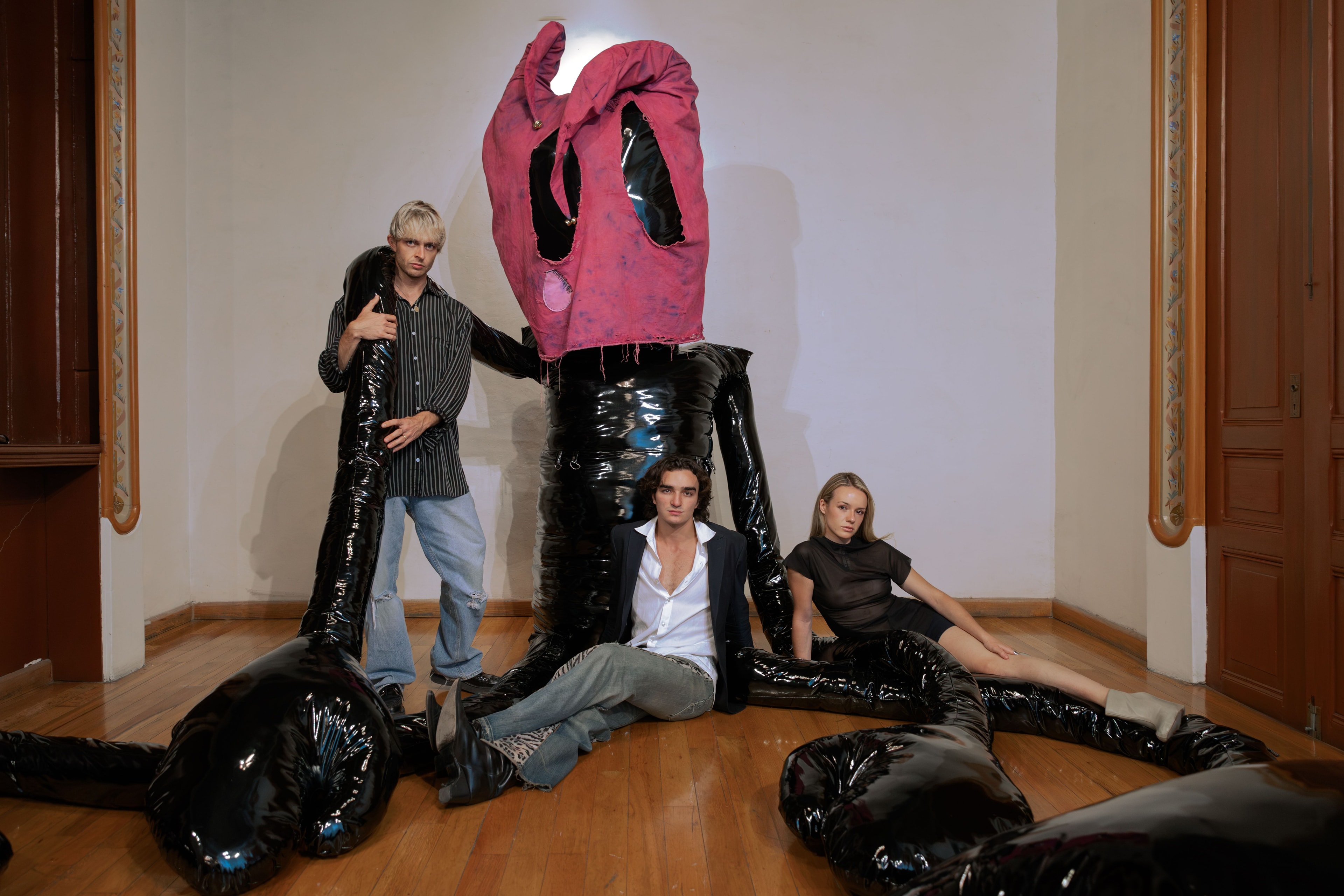
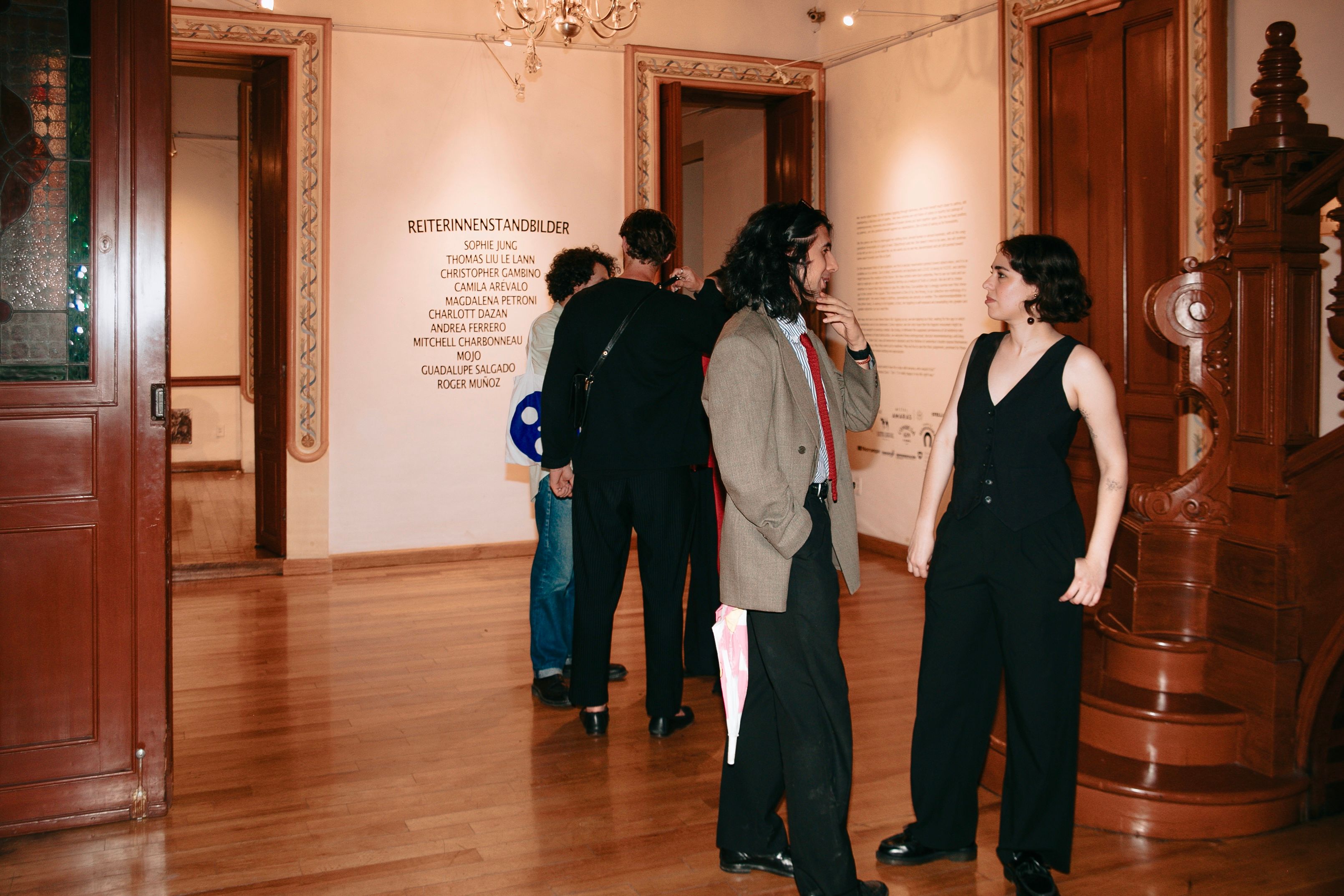
One year later, Karas has linked with Eleanor Hicks and become nomadic, moving Spielzeug to Mexico City for the next few months. “Reiterinnenstandbilder,” an eleven-person group show held in a Porfirian mansion, proposes a response to their question: “How would monuments behave when they tear open rifts into the void that they otherwise attempt to cover or repress?” Like their previous presentations, the works find affinity with the becoming-animal, the psychoerotic, and the abject. Karas describes the works he loves as “being suffocated by their form.” Before they packed up for Mexico City, the duo behind Spielzeug gave me a preview of the show, discussing everything from contemporary art’s failure to reach monumentality to the eroticism of erect monuments.
Lily Kwak: Let’s start with your exhibition title: “Reiterinnenstandbilder.”
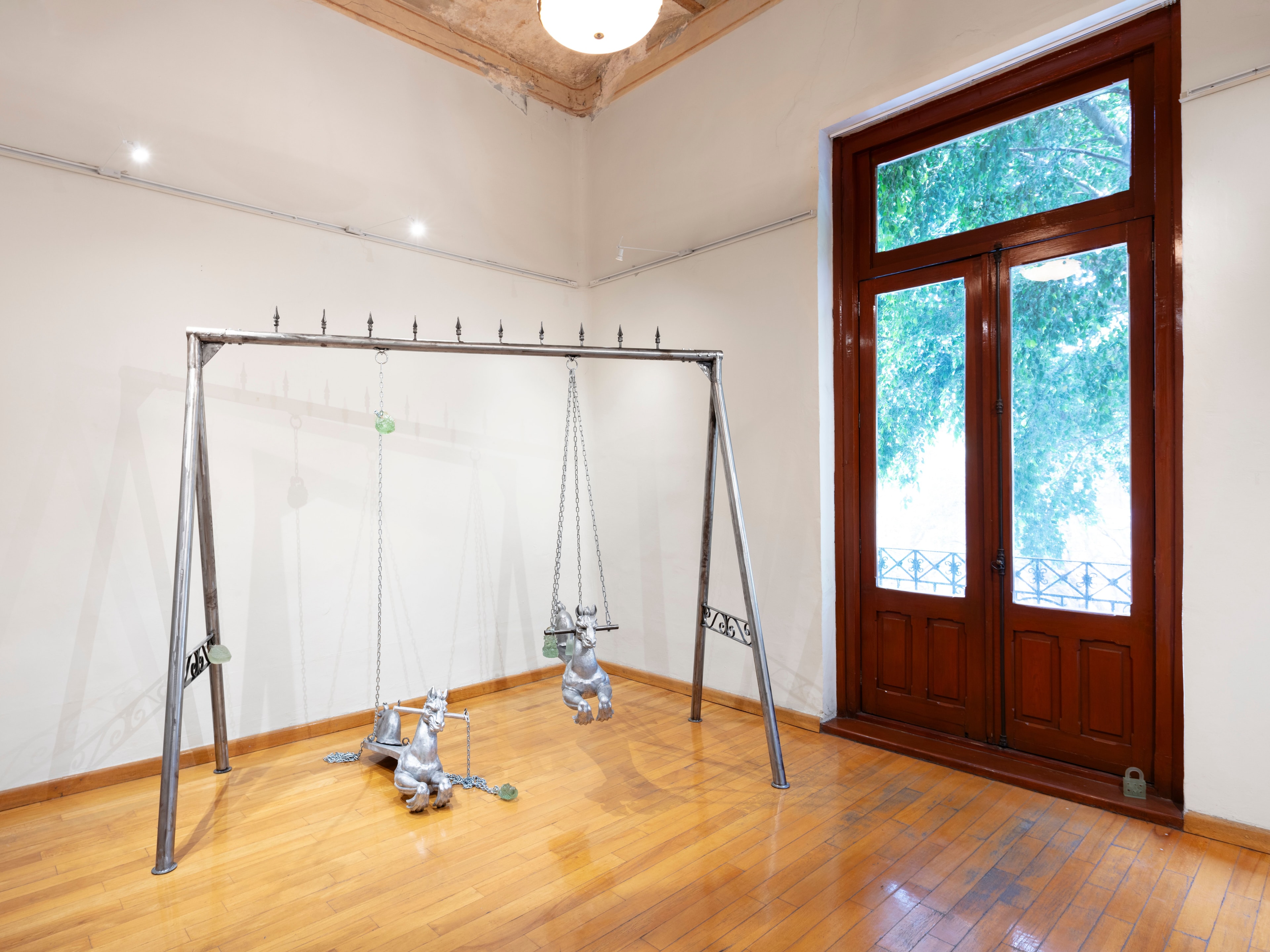
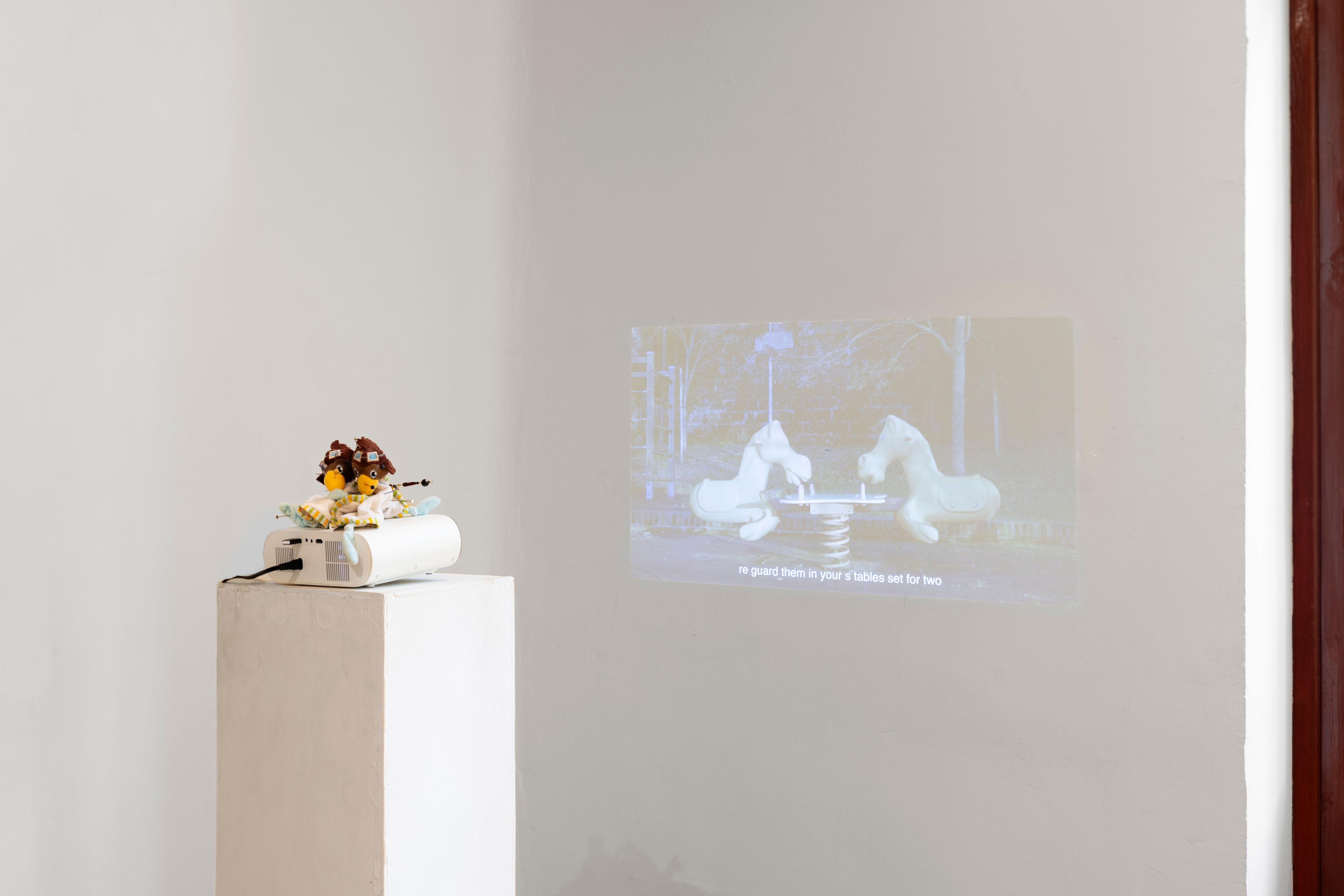
Evan Karas: “Reiterinnenstandbilder” is the German feminine compound word for equestrian statuary, so statues of white dudes on horses brandishing swords, and other phallic substitutes. The entry point into thinking about this show came from a Sophie Jung installation we presented at Basel Social Club 2025, titled Reiterinnenstandbild. Remember her piece of the degenerating carousel horse with the pole and a super faint techno beat coming out of its ass? Reiterinnenstandbild was like Sophie’s anti-monumental self-portrait. When we think about this genre of monumental statuary, it’s like the sculptural equivalent of a man buying a lime green Lamborghini or constructing an erect dick to be historically worshipped. It’s hyper-masculine, 26-tons, heavy, oftentimes referencing problematic military conquest. A lot of man energy. Pretty gay.
Anti-monumentality and anti-climax were such important conceptual dimensions of Sophie’s 2025 presentation, and it’s an idea that has rather fiercely infiltrated our program.
LK: And of course, very relevant to your most recent show in New York, “MAR-A-LAGO FACE.” Many of the works were rearticulating Trump’s gilded fetish or fascist aesthetics.
EK: Totally. That gilded, gaudy, self-aggrandizing, megalomaniacal aesthetic. The fucking North Dakota bronze statue of Kristie Noem, like crazy.
Eleanor Hicks: Each show has a lot to do with the context of the exhibition space. As you know, we’re an itinerant gallery. We move into different spaces, often derelict, but in this case, a two-story Porfirian mansion built by Manuel Gorozpe that now houses the cultural center of the state of Tabasco.
I was in Berlin this summer thinking about the conceptual framework for the show, and I went to the Soviet Memorial. I knew it would reek of monumentality, and I was pleasantly surprised to learn that it exceeded all expectations. Standing in a corridor made of a repetitive concrete situation is a gigantic sculpture of a Soviet soldier carrying a crying German baby with a massive sword while stamping on a giant swastika. It’s fucking hardcore. I was sitting in front of it, and I was like, what is our human need to build something like this? It is very clear that there is a materiality to power. For this show we are interested in what, artistically, can signal the inverse. Anti-monuments to fear, worthlessness—
EK: Immobility, weakness, fragility. A majority of the work is freestanding sculpture, and each room is set up like a vignette. It’s like a disorienting sculpture park. You walk through grand rooms where, architecturally, you’re given a monumental setup. Then we build out an intricate system of punchlines.
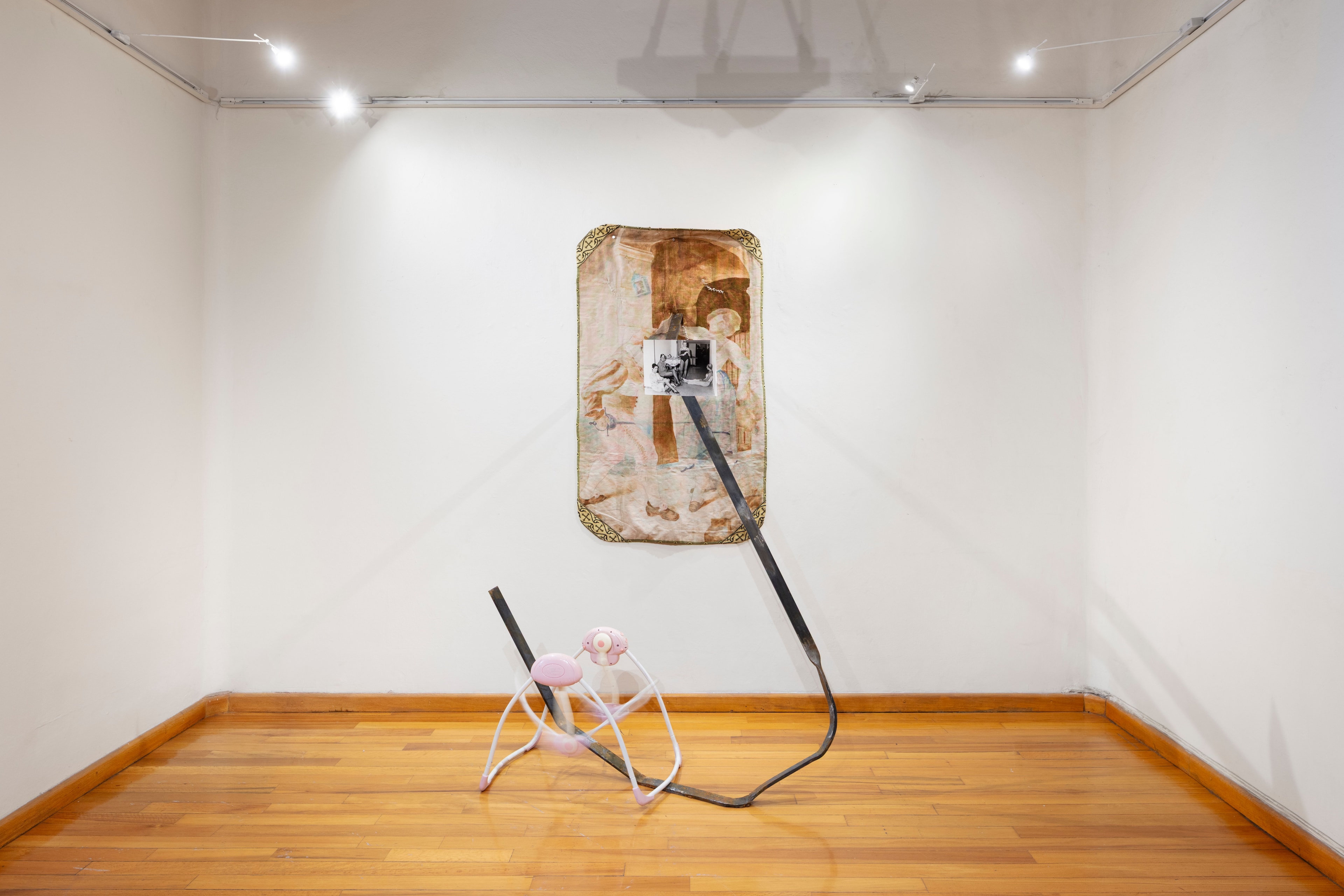
Some sculptures feel lost or almost abandoned, others function like jump scares, others have this brilliant feeling of anti-climax, others are almost hypnotic gateways into the void. For Sophie Jung, we have two works across the room from each other, and a number of small sculptures from her “Transitional Object” series scattered throughout the space. One of the larger works, To Snare a Sensibility in Words, consists of a tapestry depicting a woman getting stabbed and an aggressive umbilical metal bar that swoops into a pink baby swing. You turn on the baby swing and it plays a little song in one of those shitty speakers, rocking back and forth and progressively tapping the metal.
EH: It sounds like someone in a room far away is banging their head against the wall. It’s super disorienting but also addicting and magnetic.
EK: It’s like infantile asylum realness. The hypnotic, almost abject dynamism in this sculpture feels like it has to do with bringing time’s passage to attention. Memorialized, infantilized, eternalized, immortalized time.
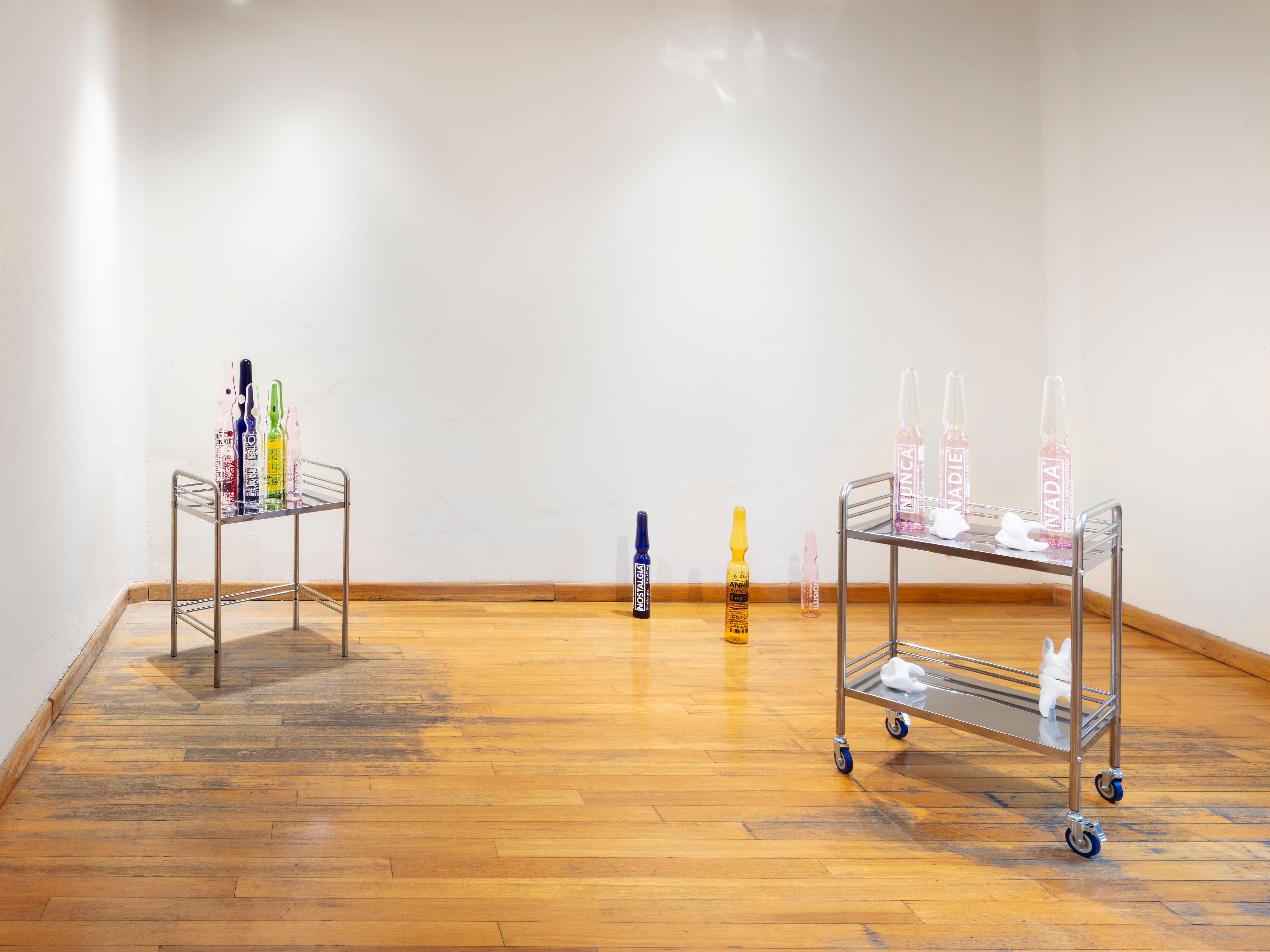
A great way to describe what we’re going for with the show is exploring the different choreographies with which works of contemporary art fail to reach a kind of architectural and artistic monumentality. And in failing to reach them, how do they tear open rifts into new forms of meaning-making? I love the dick jokes implicated in it. The obelisks, victory columns, they’re all erected. Essentially, they’re engorged, they’re turgid. They’re literally erected statues. That is the word that we use. What we’re super interested in is, how would monuments behave when they invert. When they tear open rifts into the void that they otherwise attempt to cover or repress. The disobedient monument. The goal is to make people plunge into sculptural orifices.
LK: How did you install the works? How’s the punchline set up?
EK: Every work functions very differently as you walk room by room. Mitchell Charbonneau’s sculpture, for instance, is meant to lean in a corner. Imagine you walk into a huge room, there’s nothing in the center, and there’s two perfect dupes of burnt-out fluorescent light tubes leaning against the wall, referencing the phallic obelisk shape, but at the same time made of the most fragile material. It’s precarious.
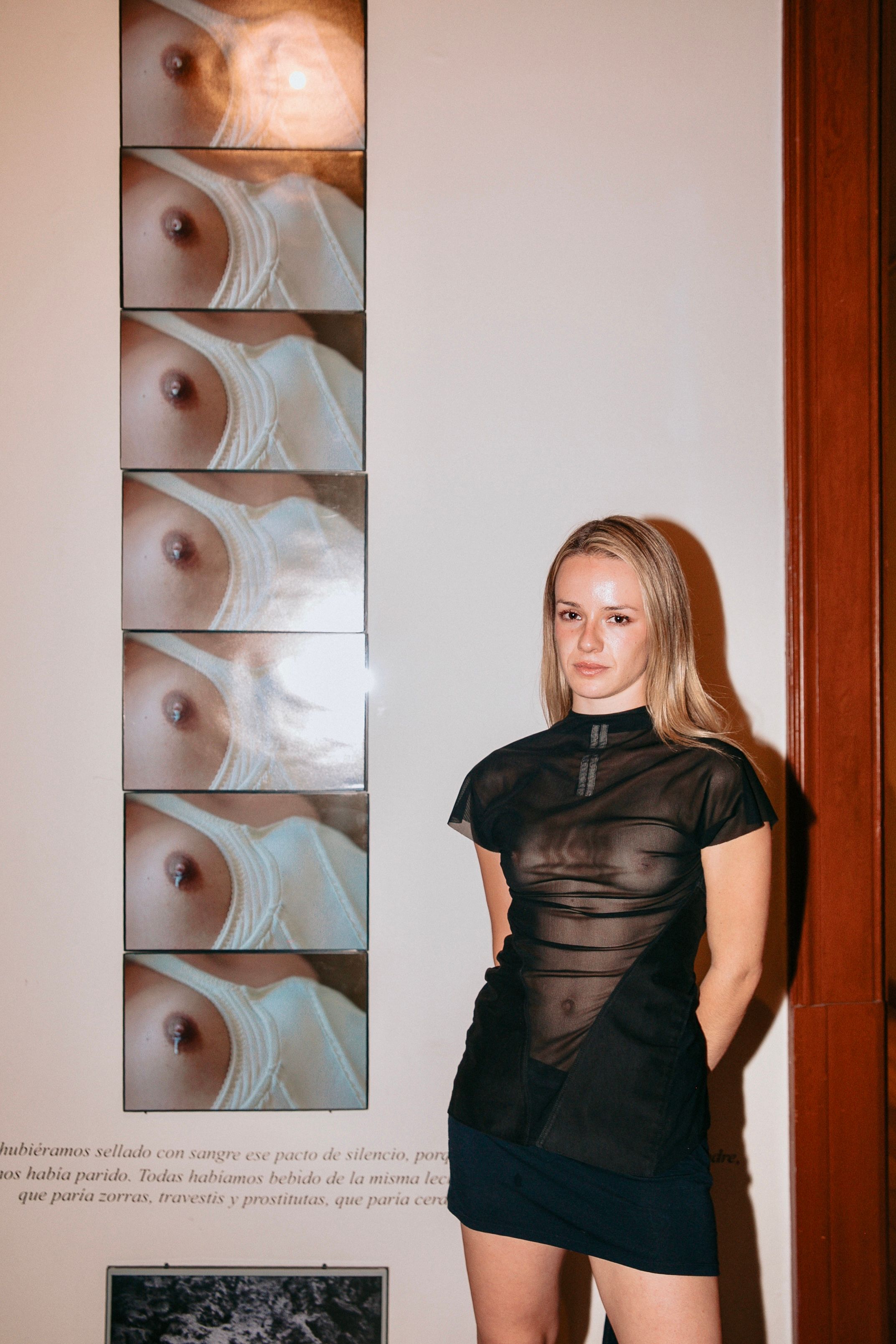
When you enter, there’s a grand staircase where, at the top, will sit Camila Arevalo’s altar to the anti-Madonna. The piece comes from a durational performance where every four hours for about eight months, she pumped her breasts and experimented with different dosages of hormones supplemented with lactation inducing drugs. It’s seven photographs of the first drop of milk that she ever produced. There’s a video and sound installation of crickets chirping superimposed with this thwap of breast pumps pumping. There’s a vinyl quote underneath from Camila Sosa Villada’s Las malas which is about trans prostitutes in Columbia who find a baby that’s freezing to death in a ditch and they rescue this baby, bring it back to the boarding house, and the mother figure, Auntie Encarna, who’s 179 years old, recites a beautiful line about how the baby, because it was rejected and forgotten, is now born from the same mother that birthed thieves, whores, and travesties. It’s a beautiful altar-like work that sits at the top of the stairs. It almost hovers above viewers as they approach. You must look up towards the majesty.
LK: How did you decide to move your nomadic project to Mexico for the next few months?
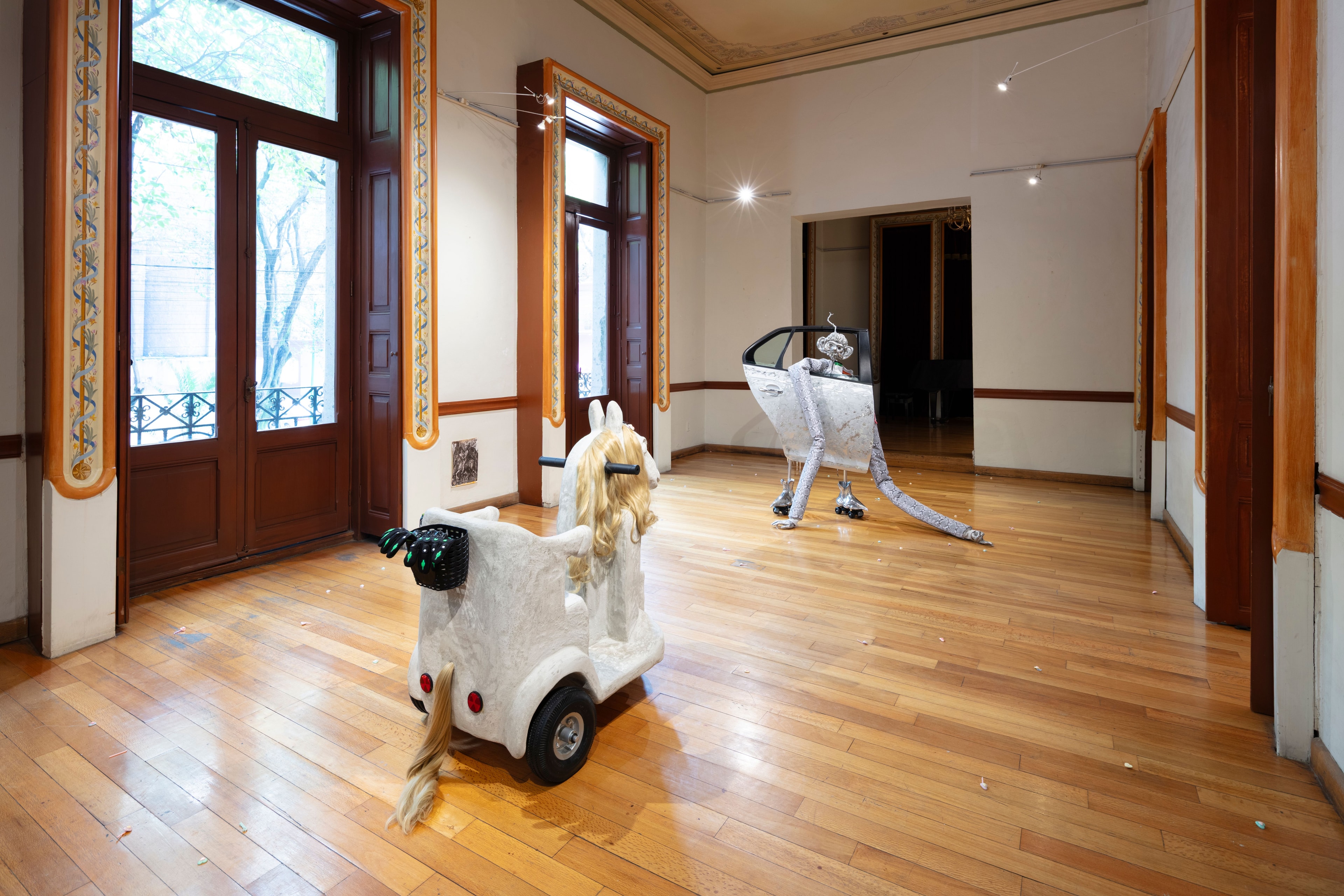
EH: We were graciously invited by the director of Casa Tabasco through our fabulous diva, artist, and executive producer from Norway, Charlott Dazan. She was truly the fairy godmother that made this show possible and her two sculptures in the show are such a riot. She produced two new works based on a hilarious and absurd event in 1839 where the 13th Earl of Eglinton tried to hashtag bring back chivalry. It was supposed to be this grand spectacle of medieval knightdom revivalism, but heavy rain and overall horrible execution made the event completely fail, leaving the duke bankrupt. Installed in the grand foyer, Charlott will stage this awesome jousting showdown between a cast aluminum troll emerging from a discarded Volvo door with these crazy cool metal roller skates, and a sculpted concrete mobility scooter pony named Rachel. Her work is completely absurd but has this incredible narrative nature to it that initiates the exhibition in a really important way.
EK: The roller skates are batshit crazy. Imagine a fucking knight in shining armor that’s a 1980s fitness gay on roller skates going down the Venice Beach Boardwalk.
EH: Exactly.
LK: You’ve worked with Thomas, Sophie, Christopher [Gambino], and Roger. Can you tell me about their works in this show, and then those of the artists you’re working with for the first time?
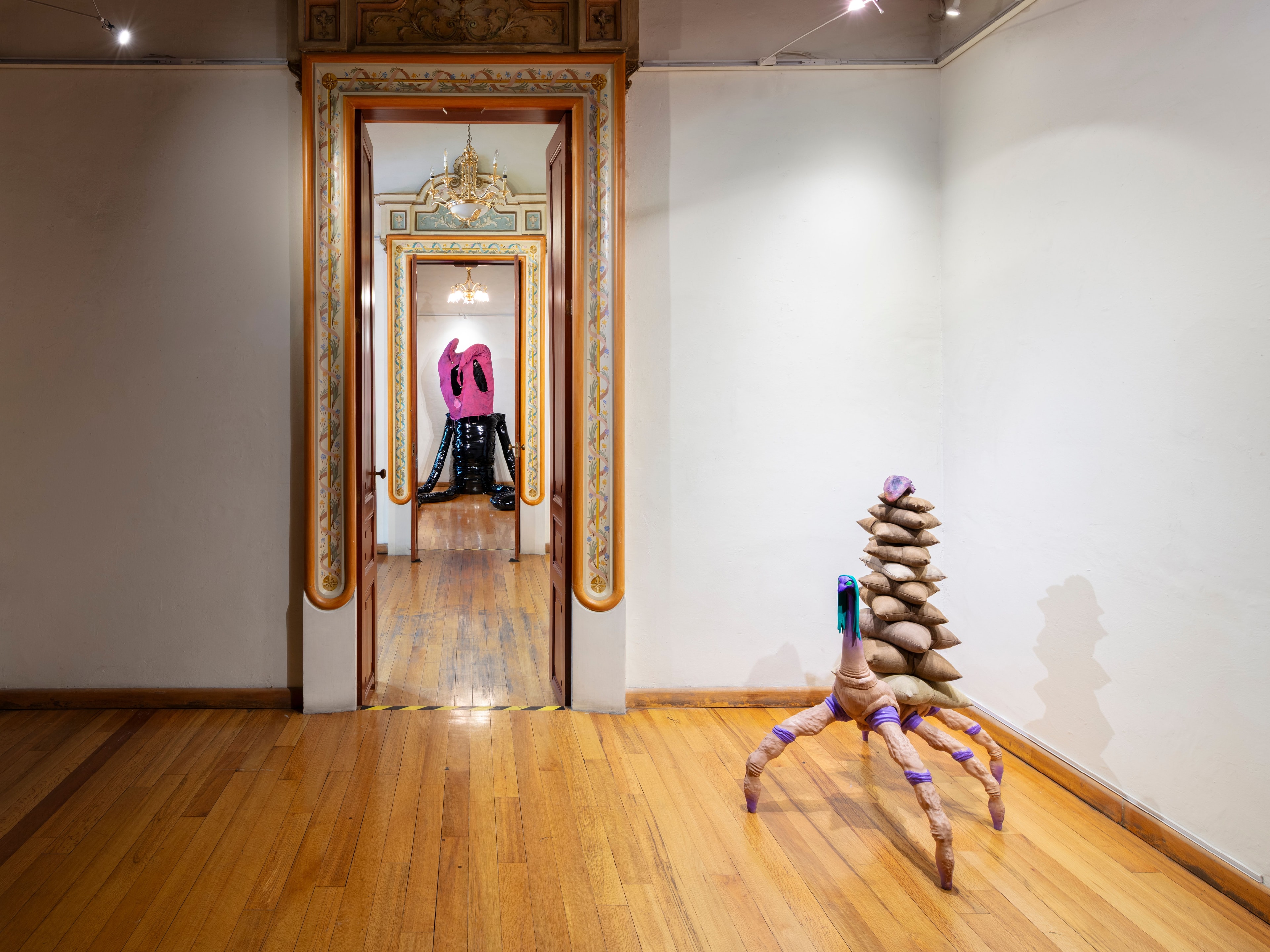
EK: Yes. The legs of Thomas’s Soft Hero go out around 21 feet. This series works as a softening of the ideal body, Übermensch type of bronze sculptural situation and creating monumental figures that stand for exalting the eccentricities of queer existence, failure, and learned helplessness. Thomas made the only other one of a similar scale for LISTE in 2021, when he was presenting with Vin Vin, and it was acquired by daddy Lukas Jakob, who is the greatest fucking person and a massive proponent of Thomas. We still have a group chat with the four of us called “Chicas” from when we were romping around Basel.
I was originally thinking we would try to loan the work from Lukas, and then I asked Thomas, “Would you ever make another one?” He was sort of like, “Sure, let’s go.” And it was a great illustration of the support we’ve received for this exhibition. Every friend we have in Mexico City is pulling strings and being so generous with their time, with their resources, their advice. A wonderful confidant has helped us with a place for Thomas to stay while he is in Mexico creating the work. A friend also connected us with a local designer to help source the long and complicated list of materials to produce this humongous sculpture. The work ended up being titled Iñigo after him, which is cute.
There’s a particular recipe that we’re coming to in this exhibition that’s unlike anything that we’ve done before, where, dare I say, this show is incredibly elegant and chic as fuck. It’s high octane, it’s ridiculous, it’s fun, but it’s sleek. The objects are sexy. The artists' perspectives are as brilliant as they are humorous, and they’re executed and fabricated in such a way that is just stunning. It’s such a fun thing for us to go from “MAR-A-LAGO FACE,” which was in this molding, degenerating fucking dinge hole of a building to Casa Tabasco, which is literally the uber-grand Porfirian x Rococo collab style that we were making fun of in “MAR-A-LAGO FACE.” As long as we put on a fabulous show, host fabulous groups of people, stand behind our artists proudly and speak on their work, give every single shit in the world about the things that matter, and don’t give a flying fuck about the things that don’t, we’re golden.
Credits
- Text: LILY KWAK