Nostalgia Reliquaries: Andrew Durbin Revisits the Afterlife of Peter Hujar and Paul Thek
|LUNA SFERDIANU
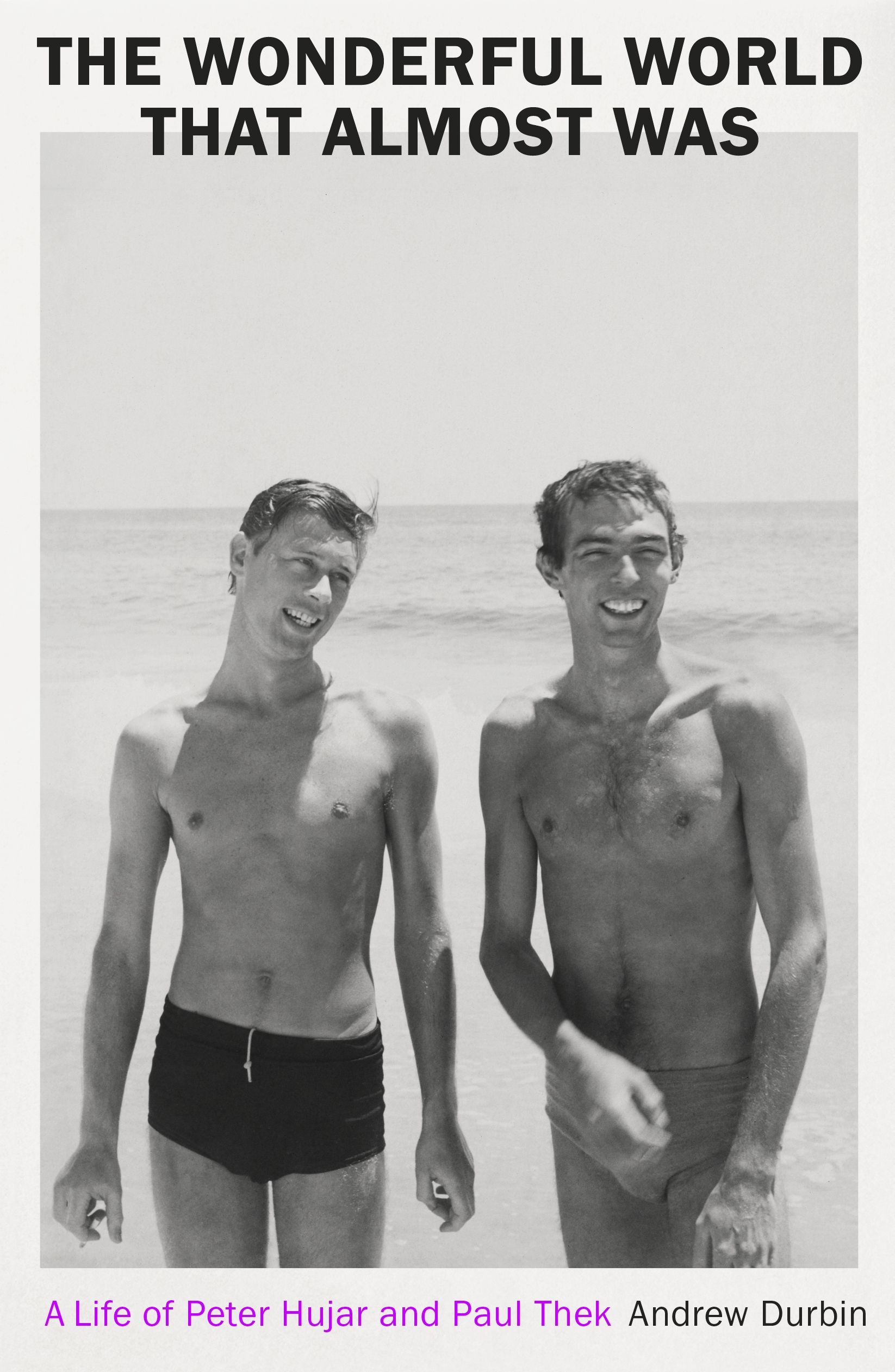
In 1967, Paul Thek’s deftly titled Technological Reliquaries culminated in a full-scale effigy of himself: dressed up in a pink suit, cradled in a pink ziggurat, at long last delivered from the machine age and its debasement of art and feeling. A portrait of him working at his own wake — one of the few remnants of the piece itself — was taken by Peter Hujar, his life-long, if flitting, lover and kindred spirit. “He dreamed of escape because there was none,” Andrew Durbin writes about Thek’s The Tomb, the sculpture that rendered Thek an innovator in the bounds of installation art (a credential that faded out into anticlimactic obscurity a few years later). His geographical inconsistency and shirking of the rites his milieu demanded of him reduced Hujar’s lover to what Susan Sontag dubbed as a ‘footnote.’ Peter Hujar, with his tenuous connections to the art world in his lifetime, gained full-fledged recognition only in the mid-aughts, along with the mass reorientation towards the AIDS crisis and its artistic bequest. The only book published before his death, Portraits in Life and Death, included revered portraits of Susan Sontag, a dying Candy Darling, and the last photograph he took of Paul Thek — the material swan song of Hujar’s brief, evocative life. Alternatively, it stands as a visual monograph of the world that both men, at the time in their 40s and out of contact, once shared.
However preoccupied with death Thek and Hujar’s artistic genealogies may appear, Andrew Durbin dredges up the liveliness that lies their foundation. Earlier this year, Durbin — editor-in-chief of Frieze and previously author of MacArthur Park (2017) and Skyland (2020) — launched what I’ve been lauding to anyone who’d listen as one of the most ambitious projects of our time. The Wonderful World That Almost Was: A Life of Peter Hujar and Paul Thek, apart from composite narration and exacting research, fulfills a dire duty: it points to the possibility of faith in times when such beacons only seem to glint from under the patina of raging secularity.
My conversation with Durbin jumped around an array of topics related to Thek and Hujar: the billowing tides of fame, the potential fetishism of a bygone East Village, and humanity’s desperate need for myth.
Luna Sferdianu: It took you around five years to write “The Wonderful World That Almost Was.” I’m really curious how things looked at the beginning of this project. What were your main interests, what were you preoccupied with?
Andrew Durbin: I began the book in the early days of the pandemic. I’d had this long interest in Peter Hujar and Paul Thek, dating back to when I was in high school, and I always thought I would do something on them someday. The first time I tried to do so was in Berlin during the winter of 2018, when I tried to write a play. As I researched their lives, I realized how much bigger this story was.
LS: What exactly about Berlin inspired you to write the play?
AD: The coldness! I was staying in this huge drafty apartment in Kreuzberg. I was very lonely. At night, I sat in different bars to keep warm and just wrote—it didn’t matter what. For some reason, I kept thinking back to this photograph of Paul Thek with Tennessee Williams in Miami in the 1950s. It was such a mystery to me, and I was so eager to find out more.
LS: Apart from the topic being wonderful, I’m incredibly impressed by your research in and of itself. I often also call myself a researcher, but I feel like I’m disastrous at it, from a discipline point of view, at least. Your book demonstrates a specific regimen, an orderliness in its writing. I’m curious about your research as practice.
AD: This is my first biography, my first serious nonfiction, and of course I was anxious about the process. Ultimately, I found the anxiety productive—it forced me to check my work over and over again, and to pursue as many leads as possible. I treated writing this book like a detective story, and once I began thought about it in those terms, I only wanted to uncover more clues.
LS: From the top of your head, what was the most fun quest in the process of researching?
AD: Another Berlin story. I was living in Berlin during the summer of 2022 and, by chance, I met someone who was an intimate friend of one of Paul Thek’s lovers, Lily Nova. One day, he invited me to have a coffee with him. I was extremely late, and when I arrived at the cafe, I was shocked to find him still waiting for me. He wasn’t upset at all. Before we spoke, he handed me a red notebook one of Lily’s diaries which he had inherited. It was full of her memories of Paul, something no one had seen before. That really altered my book.
LS: You were already convinced you wanted to write something about the two of them back in high school, but for the record: why Peter Hujar and why Paul Thek?
AD: Hujar wasn’t a household name. You couldn’t find much about him unless you had access to a few expensive and rare catalogues. If you went to most museums in the US, his work wasn’t usually on display, because the American art world had not yet fully begun to address the scale of the loss of all of these important artists in the late ’80s and early ’90s to AIDS. So, Peter was a mystery to me, and I’m always fascinated by these mysteries—the unexplainable pull an artist has over me. Paul Thek is one of those figures so many artists love and cite. As with Hujar, I first saw his work when I was in high school, and I immediately fell in love. But I didn’t know much about him.
[Thek] was thinking about the ways in which art might create different kinds of spaces for people to inhabit—and what of art does and doesn’t endure.
LS: The art scene of mid/late-20th century New York comes across as one of the most mythically-loaded timeframes to have ever existed. I assume there’s a tinge of that playing into your readership, too. Where does this collective propensity arise from?
AD: The nostalgia for the East Village expresses a real regret for—a real discontent with— present circumstances. Nobody wants the world we live in, where every social interaction is mediated by a handful of companies from Silicon Valley, where books are chopped up to feed the machines we’re told will take our jobs and our art, where every corner cafe is run out of town by private equity, where rent is unaffordable and the only way you can survive, let alone thrive, in New York or London or Berlin is if you have some high-powered, emotionally draining job (that anyway won’t exist in six months, apparently). The East Village is this living memory of a completely different way of organising a neighbourhood, a city, and it’s within touching distance. It had a lot of problems, yes. Crime, drugs, deprivation, and so on. Of course. But when you walk around the East Village today, and it’s filled with these rich transplants from the suburbs of Virginia or Florida or California, who line up for matcha at Blank Street Coffee, you can’t help but feel sick. So yes, I understand the nostalgia, because the world we live in so rotten.
LS: This is how I feel towards things, too. But a lot of this East Village nostalgia-tripping can also activate a specific fetishistic facet. Do you think we can somehow resist the fetishistic pull towards these characters and spaces? For example, do you think there’s a differentiation between a straight up biography vs. mythology?
AD: Critics and historians have a responsibility to resist playing into the mythologizing process, but it’s also important to acknowledge that the mythic is an important part of an artist’s reception. A writer shouldn’t and can’t ignore this, but they should attempt to peel away, or to penetrate the myths to find something of the truth. But these days, I’m less inclined to shame people for their nostalgia. Who cares if someone is obsessed with a bunch of interesting painters and sculptors and writers who made cool art?
LS: I was also thinking about this, and it may be that I’m too cynical, but I believe it might be difficult for such cinematic life stories to come out of the way we live life today. And again, that’s not to shame individuals for it, it’s a systemic failure. Regular life simply doesn’t carry as much radical momentum as it may have in retrospect, thinking of those times. Are you of a different opinion?
AD: I disagree. So many people today are living extraordinary lives that will someday be told in great books. I’m sure of it. Our moment is fairly miserable, but history is full of misery. We may be living through an especially restrictive moment right now in which there are fewer opportunities for people—particularly working class people—to take the kind of chances you might take if the cost of living weren’t so high. But these artists are out there, and their stories will be told.
LS: I’m trying to feel that too, but I’m a victim of the era’s nihilism.
AD: Yeah, the world is ending, so it’s hard not to feel this way.
LS: If I remember correctly, Peter was the one to assume his post-mortem boom in the art world, whereas Paul didn’t. Especially in the beginning of the book, Paul seems to have had this almost inalienable, childlike perception of the world. He was very curious, very jovial, but as the book progresses he grows somewhat more nihilistic. At some point, you mention that “he dreamt of escape because he felt like there was none.” He had a tenebrous view of the art world and an acute sense of the societal pessimism in America. Do you think they shared the cynicism, and do you think like it factors into their art and their arc?
AD: Both men who dealt with depression in different ways. It was one of a few things that affected their ability to function within the normative framework of the art world. But I wouldn’t call either of them cynical or nihilistic. I would say they had an unyielding belief in their own vision, and that vision often didn’t comply with the expectations of the world they were living in. That would frustrate anybody.
LS: In a 1976 notebook quoted in your book, Paul Thek goes: “Perhaps so much of our art now says nothing, means nothing, because if art really did begin to speak, it would seriously threaten our lives, our ‘lifestyles’. But an art that says ‘nothing,’ that art is of no particular danger to anyone or anything […] But meanwhile, as we know, the planet edges… very quickly now too… towards the real extinction.” I wonder, as a researcher and also again as editor-in-chief of Frieze, how do you see this little musing in the status quo of the art world?
AD: It’s fairly rare to encounter an artist writing in the mid 70s about the destruction of the planet. Reading Paul reflect on climate collapse, civilizational disorder was a total revelation for me. He was thinking a lot about American imperialism, the destruction of the environment, the alienation and isolation emerging from a highly technological society like ours. His work includes an economic critique, but I wouldn’t narrow it to the art world, though it’s certainly part of it. At the time, he was creating these large-scale, temporary environments. He was thinking about the ways in which art might create different kinds of spaces for people to inhabit—and what of art does and doesn’t endure. He was generally frustrated with a society increasingly lacking faith and wonder.
LS: At last: what are your main takeaways from this project, and what do you wish for it to inspire in people?
AD: I hope readers, particularly young readers, take away a sense of art’s possibilities, that you can do whatever you want, that art doesn’t have to look like something you recognize or can even explain. You don’t have to follow the rules, whether they’re imposed by school or the market or a gallery. All that is so extremely uninteresting and unimportant to the process of making art. Don’t worry so much about what people will think. Just make art.
Credits
- Text: LUNA SFERDIANU