Namasenda Sounds the Now
|LUNA SFERDIANU
Have you noticed how we’ve been sifting through the same references to the point that their meaning has been pulverized? Namasenda has, and she thinks it’s passé.
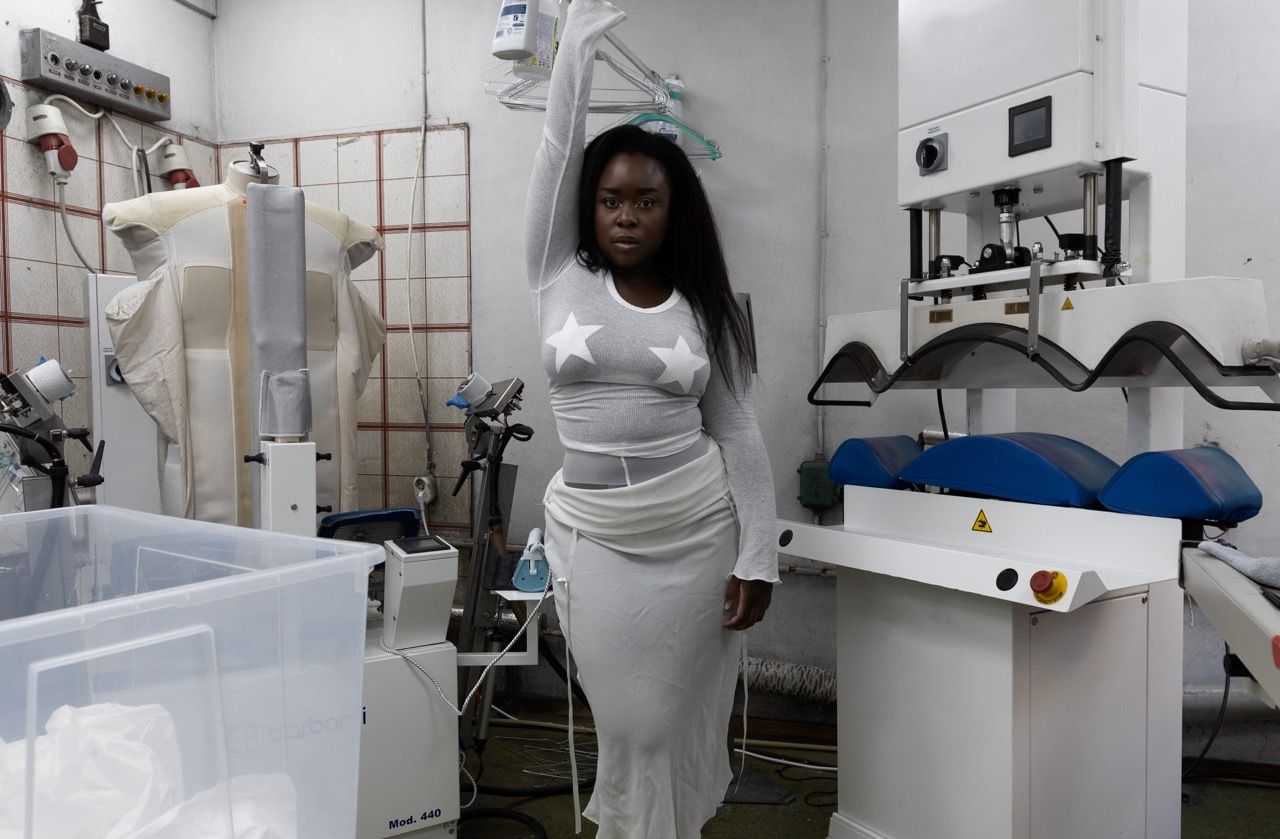
However, even when uttering her adamant opinions on our culture’s habitual nostalgia-tripping, the Swedish singer doesn’t do so with the holier-than-thou cynicism that normally precedes such a remark. Instead, she simply refuses to dwell on the past, and Limbo, her newly released album, attests to this ideology.
The term “limbo,” both in its Christian denotation as the interstitial space between heaven and hell or its colloquial use, refers to a place of deep stagnation. Both interpretations fed Namasenda’s most intimate album to date, where, after a period of languishing, she heaved herself out from this ruminative purgatory by hitting the studio and allowing herself to be vulnerable in her return to her day-one commitment: the “perishable good” that is pop.
To cherish this moment of release, the artist called me last week from her Stockholm apartment to talk about her emotional journey over the past few years, our Instagram-mediated connectivity, and Rachel Sennott’s I Love LA (2026).
Luna Sferdianu: Culture has a very convoluted relationship to pop. Back in the day, it was often deemed antithetical to “real” music by avid “musicheads.” Now the paradigm has shifted entirely. What is your relationship to pop?
Namasenda: It’s a broad descriptor. I think you can put the pop stamp on almost anything. I’ve always been interested in pop culture. It’s my life. It’s going to be exciting to see what people say in 10-15 years from now as well.
LS: The album’s name is Limbo. Can you immerse me in the specifics of this limbo state you were experiencing when you were making it? What did that look like emotionally, spiritually?
N: Both emotionally and spiritually, it was pure panic. I had all these dreams and aspirations, and there were so many things that I wanted to do. At the time—for the first time in my life—I started thinking that maybe I won’t get to experience them. I started wondering about what I was doing.I had never thought about quitting music, it’s just that Istarted to worry a lot about how I would be able to reach my goals.
But I realized very quickly that no matter what I think, I just have to get in the studio and continue working and then everything will sort itself out, which I feel like it has now. The album is out, and I finally see the light at the end of the limbo.
LS: When you say panic, does that reflect a personal relationship to music, or a universal feeling aboutthe world currently?
N: It was about not knowing where to go next. It feels so trivial to think, Oh my God, I need to make this album when the world is burning. But I feel like art is extremely important in times like these.
LS: And how did this previous state evolve?
N: I told myself I just needed to see what happens. It feels like this album happened to me. I went into the studio and every day felt like I was downloading things from the universe. I was writing so much, I had so many things to say and so many things to talk about. I was looking through all the videos from the studio from that year, and I wonder how we made an album, because every video is just us messing around.
LS: The results show that. The album is so expressive. The Limbo cover image is sultry and restful, as if you’re being watched lying in bed through a piece of glass. I was actively listening to the album and looking at the image at the same, and it created this paradox because the sound of Limbo is somewhat opposite to lying in bed or to stagnation. It’s volcanic, it has a lot of momentum. How did you decide on the album’s visual component?
N: The bed is obviously very soft and flowy. I am bed-rotting, but then I am still in this weird space, this hard surface that I’m pushed against. My music,to me, is about softness versus the hard kick, the softness of my voice versus a strong synth. We wanted the imagery to show that: being underneath the covers and still trapped underneath glass. I feel safe, but I simultaneously don’t.
LS: The scene’s domesticity reminded me of the “Bad Love” music video. The viewer, orlistener, is granted access into your intimate sphere, but especially in the music video, it’s this liminal domesticity — it’s a bedroom, but more of a backroom atmosphere than an actually inhabited place. Do you relate the feelings of fear, confession, uncertainty that the album tackles with this homely atmosphere, and having it also pried into?
N: My earlier music and visual aesthetic were very polished and neat. This time, I wanted to show things the way they are. And that’s why we found this abandoned house in the countryside of Denmark, and went there with a very small crew and shot it the way it is, with not that much lighting. What you see is what you get.
I’m trying to be comfortable showing more of myself and opening up, because I am a very private person, but I also yearn for people to understand me,.
LS: Since it is a very personal project Is there anything on it that you fear that people might misunderstand?
N: There is the song titled “Clermont Twins.” I am afraid people might misunderstand that song as being judgmental towards them, but I love them. It’s mostly a song about body image and the things that both women and men go through.
LS: It didn’t come across as a diss to me, but clarification is important.You are quite anchored in the present, and you do not dwell too much on what came before. How does this focus on presence and the present inform your process?
N: I’ve never been a person that dwells on the past. I am dwelling more on the future, if anything. I think the past is so boring. I don't care what happened two years ago, I have no idea what happened yesterday either. I want mostly to be in the future, but I’m really trying to be in the present and make music that excites me, because I feel like there areso many things in pop culture right now that are merely references of past things. It’s getting tired. I am wondering what the next thing is. What is of the now? I don’t want to hear another 80s album. I want to hear what’s happening now!
LS: How does working in this manner feel in our current culture, which you mentioned is perennially obsessed with nostalgia?
N: I mean, it is quite boring. I am chronically online, so I see everything all the time, and sometimes you reference things without even knowing it, or at least it’s in the back of your head. Sometimes two people make the same thing without ever knowing. I would love, however, to see pop culture going in a different direction to what the sound of now is, what we are doing with the now, how we are feeling currently, instead of just looking back. Also not just looking forward either, because I used to hear so many times that my music is so futuristic. It’s not futuristic.
LS: We really exist in this polar state of art being either futuristic or nostalgic. There’s barely any terminology to describe the present in present terms. Since you are talking about referentiality, do you have any supreme icons or wells of inspiration?
N: Right now, I am obsessed with I Love LA. I reference that show a lot right now in everyday life and even some songs that I'm making. It’s so good. And I feel like TV shows and movies generally are my main inspiration in the way things can be shot, or like a dialogue that I love, like I love Rachel's writing – it’s so funny.
LS: Rachel Sennott is truly a voice of the now.Before we slightly drift away from your music, I need to admit that when I was listening to your new album, it gave me this urge to move my body right then, like it propelled me, and I’m sure that it does that for a lot of your listeners. Does your music come first as some form of physical impulse, or is it more anchored in rationality or emotion?
N: I am a very impatient person. I constantly need to move around. I’ve never thought about how that actually goes into my music, but now that makes sense to me, because that’s just how I am. I’m always very impulsive.
Making the music is not that rational, or it wasn’t this time around. It was intuitive, like it just happened, and I didn’t question it that much. I just let the words and the melodies come. I allowed my body to do the work.
LS: You grew up in southern Sweden, which as this almost mythical cultural status, similar to the journalistic obsession with the lauded “sound of Copenhagen.” To what capacity do you think Sweden shaped who you are today?
N: People are always wondering what’s in the water in Sweden. Of course, artists from here are definitely talented. But in order to even get the time and space to explore your artistry, you have to be safe. There are so many government-funded programs for children and teenagers; I had access to a studio that was paid by the government when I was, like, 10. It’s starting to change, unfortunately, but culture has been very important in this country. When you have all your needs met, you have shelter, you have food, you can be creative.
LS: Do you have any concluding words?
N: Try to find the romance in trying. That is my personal focus this year.
Credits
- Text: LUNA SFERDIANU
- Photography: LEVI AXENE