Josiane M.H. Pozi: “The Only Thing I Know Is How I Feel”
|LILY KWAK
The London-based artist Josiane M.H. Pozi says her first solo institutional exhibition “feels like live editing.” In the Beaux-Arts building of New York’s American Academy of Arts and Letters, “In Pursuit of Feeling” hijacks routine choreographies with the mediated world and stages an exhibition one might navigate as a game, or a program. Lily Kwak spoke to the London born-and-bred artist about structural film, sonic knowledge, and making a work the size of a button.
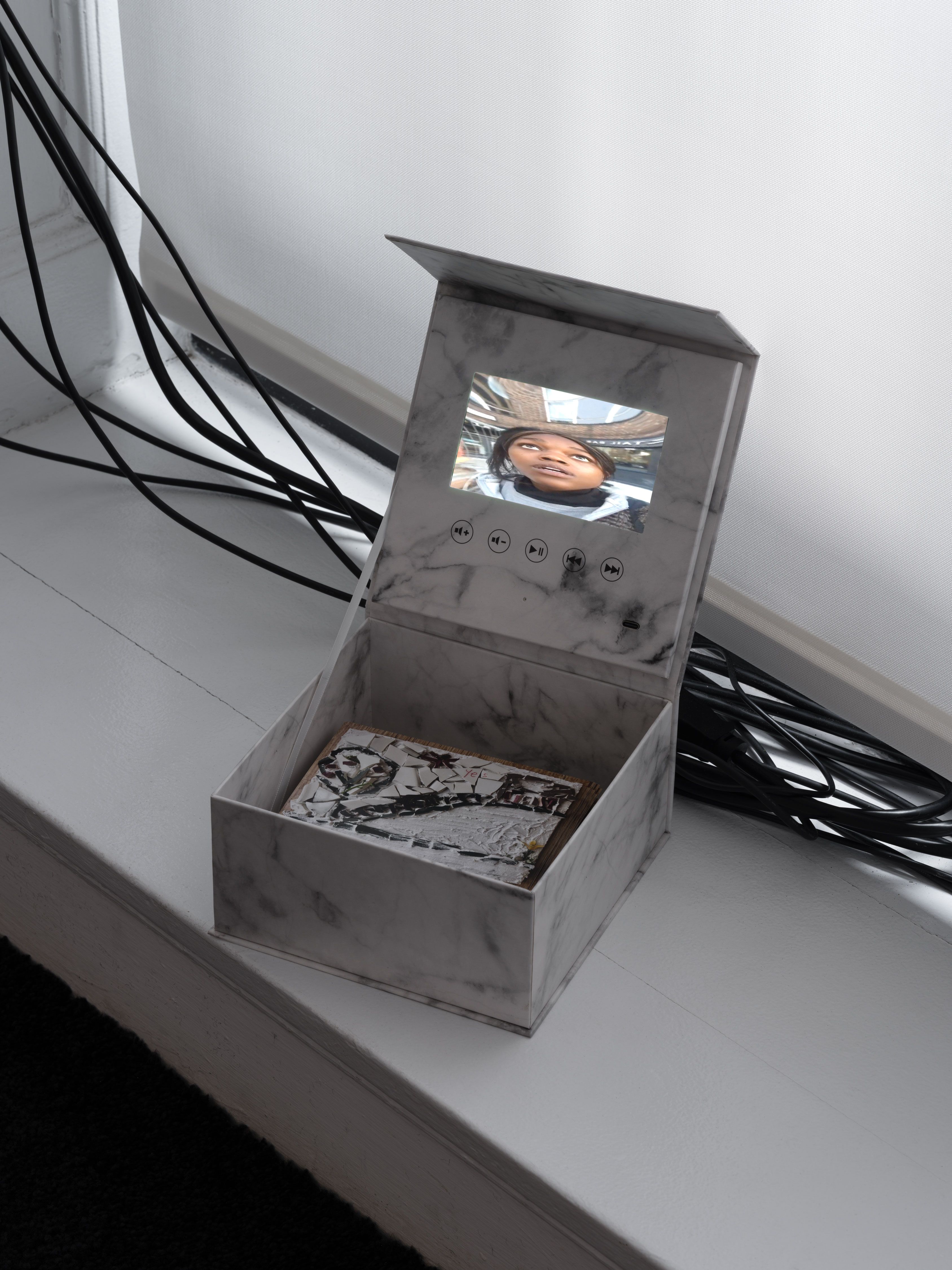
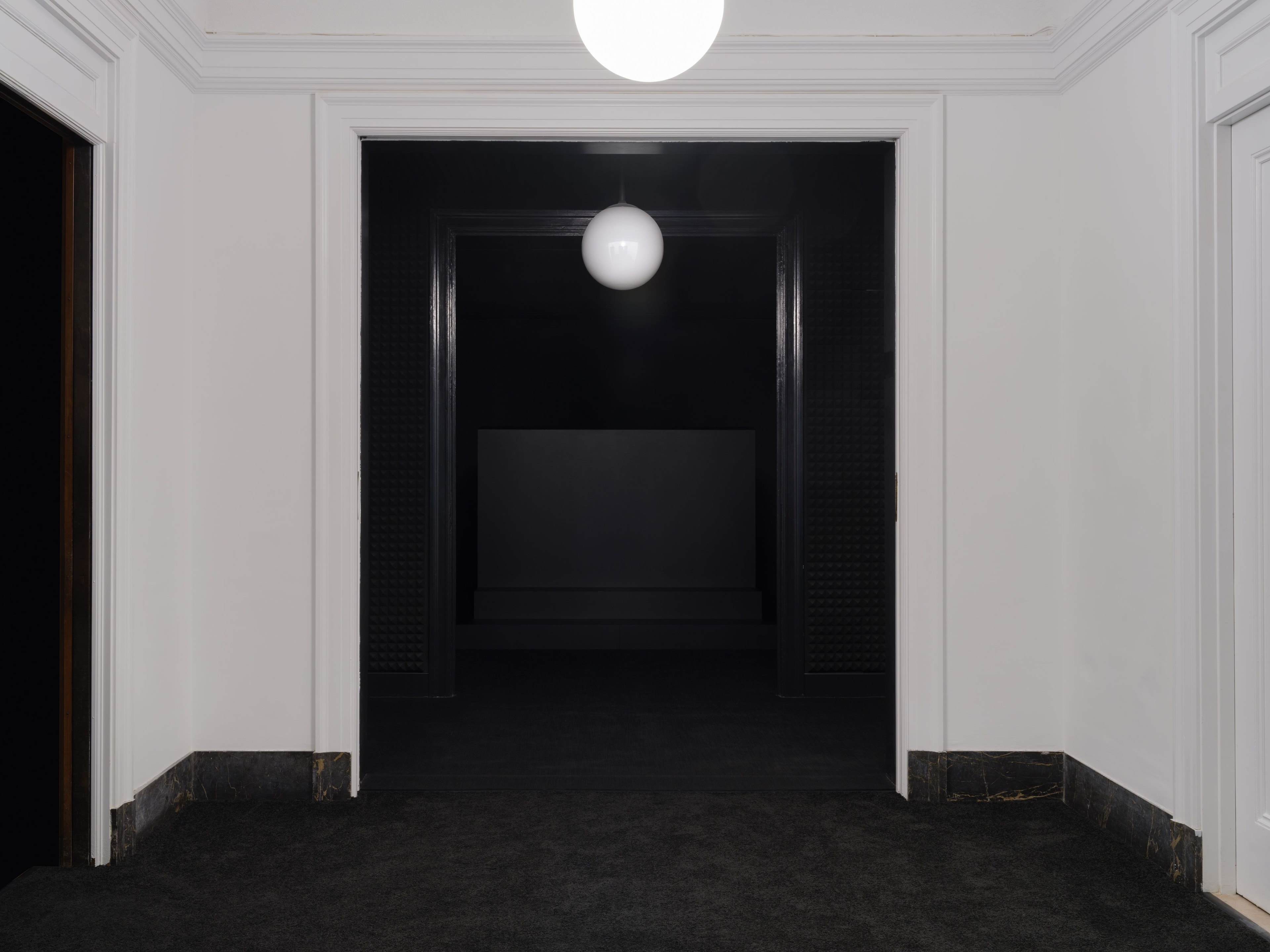
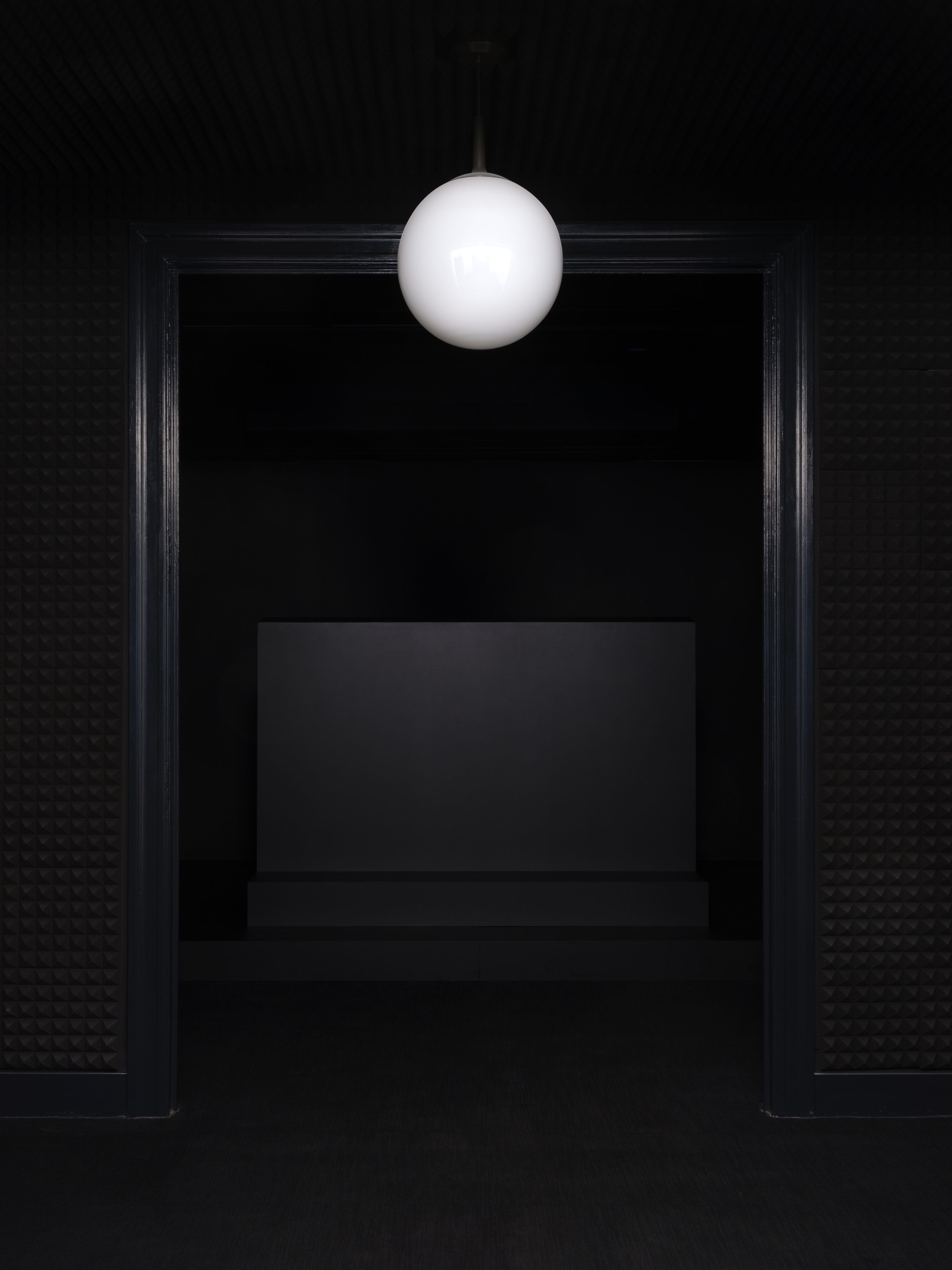
Lily Kwak: When I walked into your exhibition, the first thing I encountered was a door, slightly ajar, and a computer connected to an entrail of cables that leads out to the first exhibition room. I began imagining you, the artist, behind the computer, producing the sound that’s omnipresent throughout the show and the videos that splay across the room and jump around in a sequence, sort of like a playlist.
It felt wonderful to feel the intimacy of your imagined presence behind the door, and to observe and navigate a system you’ve designed for your audience. It reminded me of the idea of the artist as a programmer, which came out of early cybernetic and computer art discourse in the late 1960s.
Josiane M.H. Pozi: Yeah this exhibition feels like the most experiential one so far. I think because I had the role of the spectator or the act of viewership more at the forefront when thinking about installation of the works.
With video, we’re constantly confronted with images in our day-to-day lives, whether it’s a two-minute reel or something else. The act of looking has become so habitual that we rarely question our own position as spectators. We consume images almost automatically, feeling justified in watching simply because they are there to be seen, without necessarily reflecting on what we’re looking at or genuinely engaging with it. That would trip me up on Instagram. I would see something as devastating as footage of crimes against humanity, and then immediately afterwards see a selfie or something completely unrelated. The speed at which we move between these images removes any sense of pause or responsibility. We see, we scroll, and we move on, without considering what it means to witness these things. So in terms of installation, I wanted there to be an element of forced participation with the spectator. In the first room there was an 8-channel video sequence of films playing on different monitors all over the room. Each video is sequenced but only the sound was playing continuously, each video came up one by one so you had to find the video by looking around the room. In the Pingey (2019) room, you have to walk over to these small [iPhone] screens, then recognise the sound on the other side of the room and grab the headphones. It’s like a game, and you have the option to sit on the benches and look out the window. It feels like live editing or live filming. With that first door, for me, it’s about bringing my laundry or things pertaining [to] inside that crooked door, that should be concealed, into the open. My first video was Capture (2018), which is installed on the wall in the first room and connects to a little wire flower drawing. When I first making videos, I made stuff about what I knew, which at the time was looking at my family and my connection to my family. And then also wanting to make work that reflected my experience of life, divorced from how Black and brown people or any marginalized group have been typically portrayed in film, this being characters with the purpose of upholding stereotypes which reinforce white supremacists and heteronormative ideology. I wanted to make a movie that feels like my family and feels like myself for no other reason than because I can.
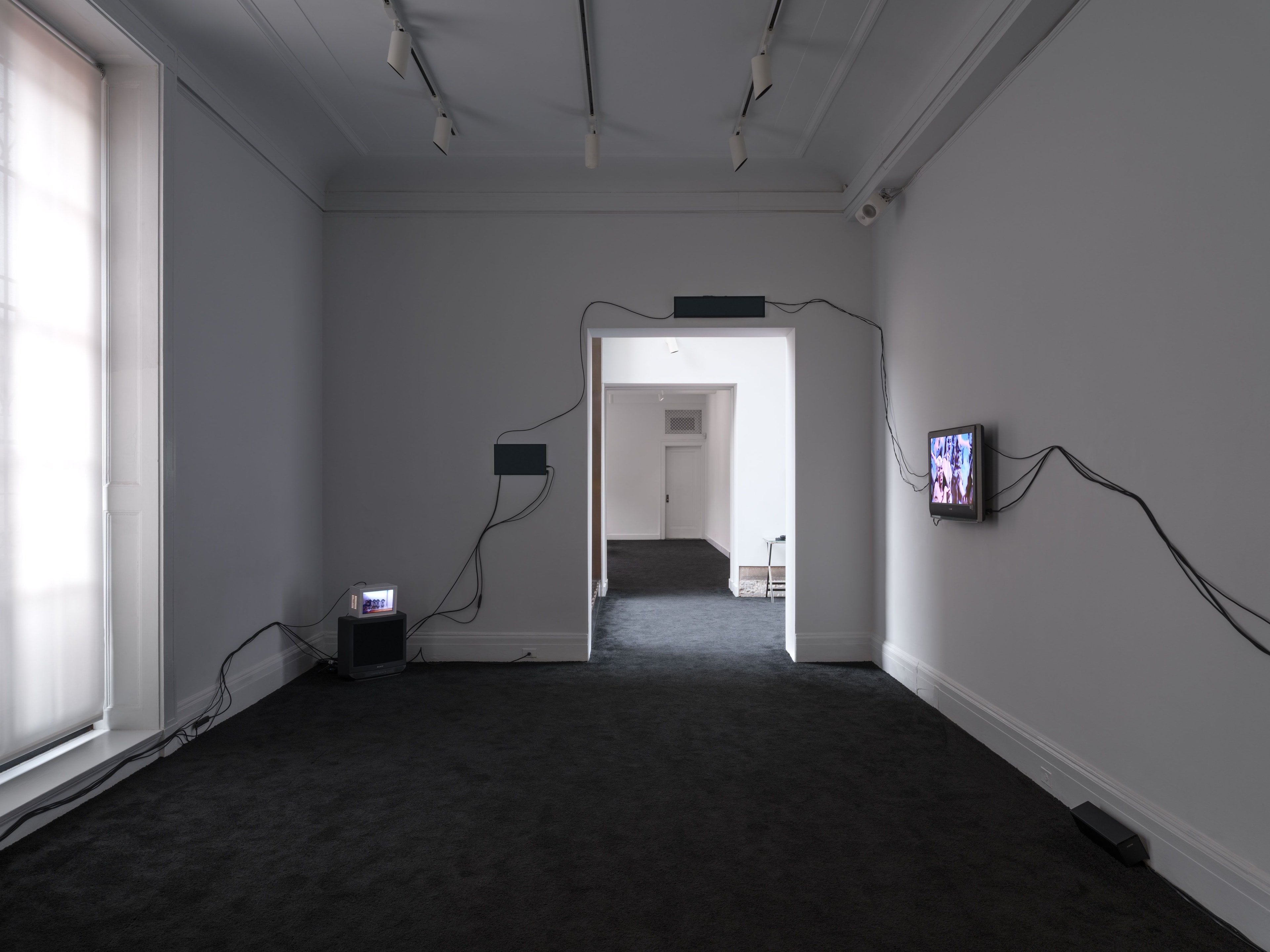
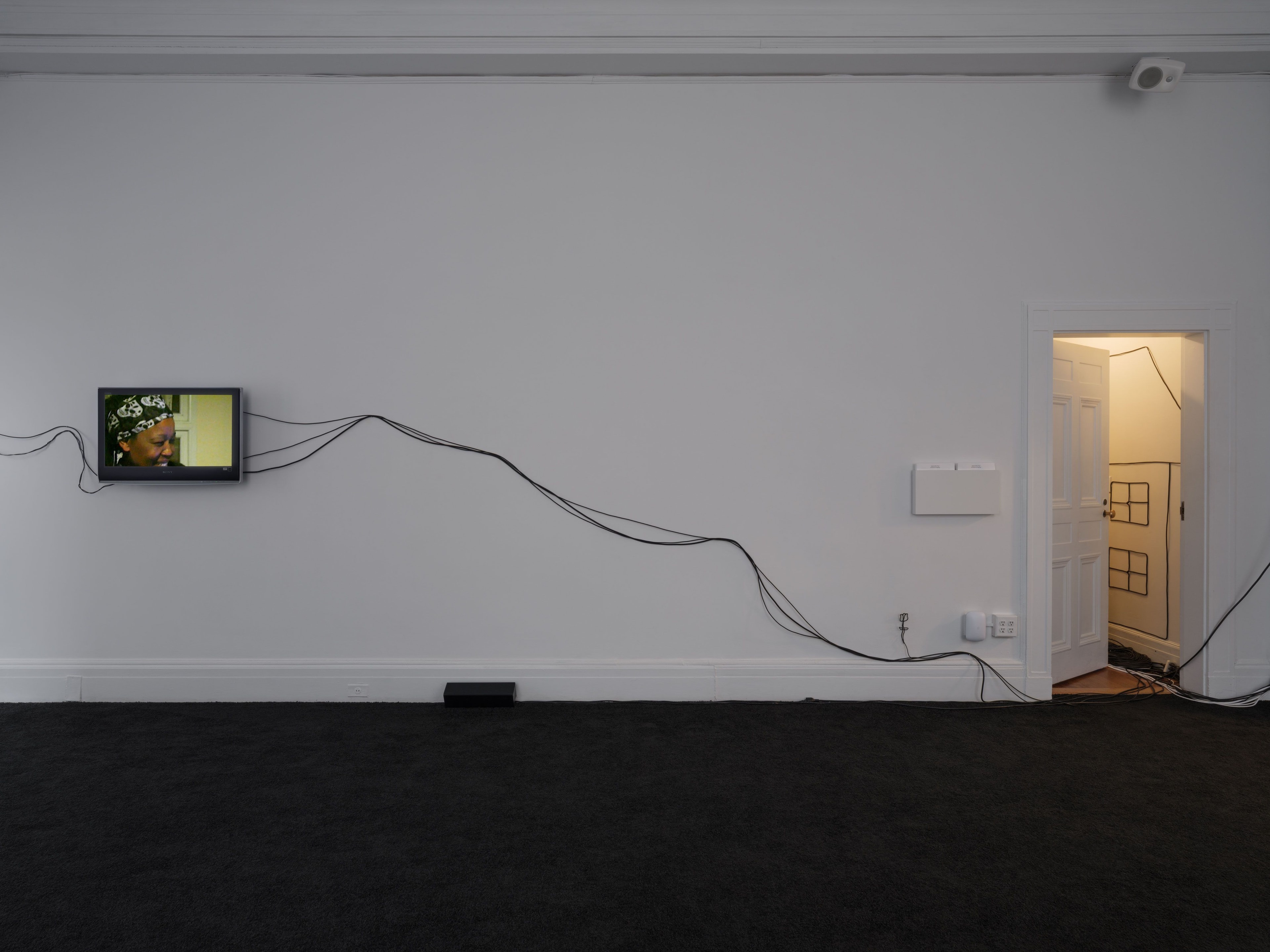
LK: When I saw Pingey at the Roxy [Cinema] in New York, where I first encountered your work, I felt an immense sense of lost connectivity, whether it’s with regards to interpersonal relations, a young person’s relationship to the world, or how images mediate relationships. This intensified in this exhibition, for instance in seeing the cables symbolized in the shape of a home.
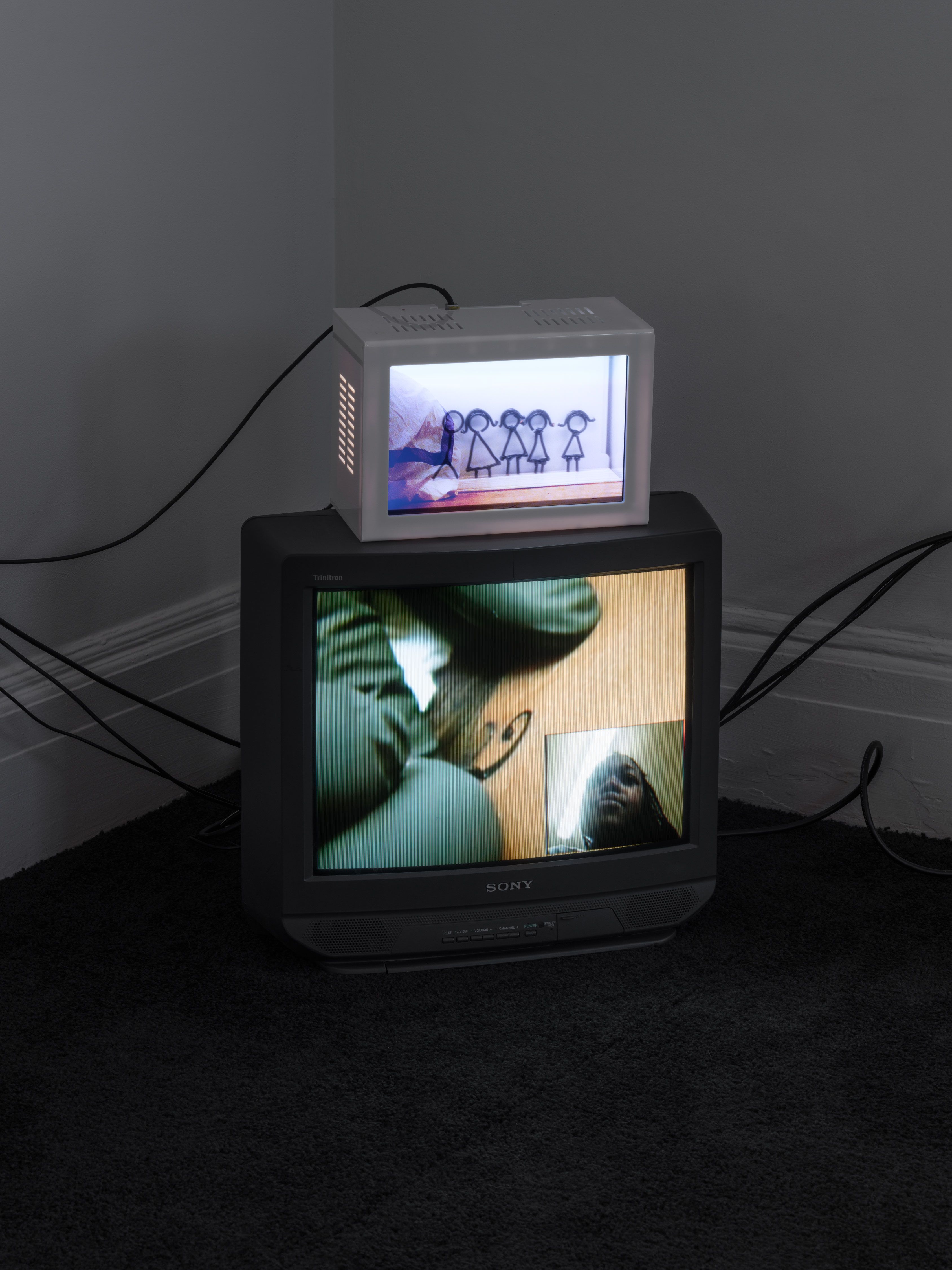
JP: That room is the most joyous for me, because there are videos that I’ve made with my family, music videos of mine as well as collaborative work with the artist Klein, Richie Culver, and Moor Mother.
As you progress from that room, it feels less and less connected from the home, kinda like leaving the house. Especially m.c. in the last room, which is shot with spy glasses from a first-person perspective. It’s the only movie I’ve made so far with the intention of people watching it and which doesn’t include myself in. In Pingey, too, there are varying levels of disconnect. That video is about forms of connection and how we connect, whether it’s feeling seen by a parent, by friendships, and also by yourself—and the performativity involved in attaining those connections.
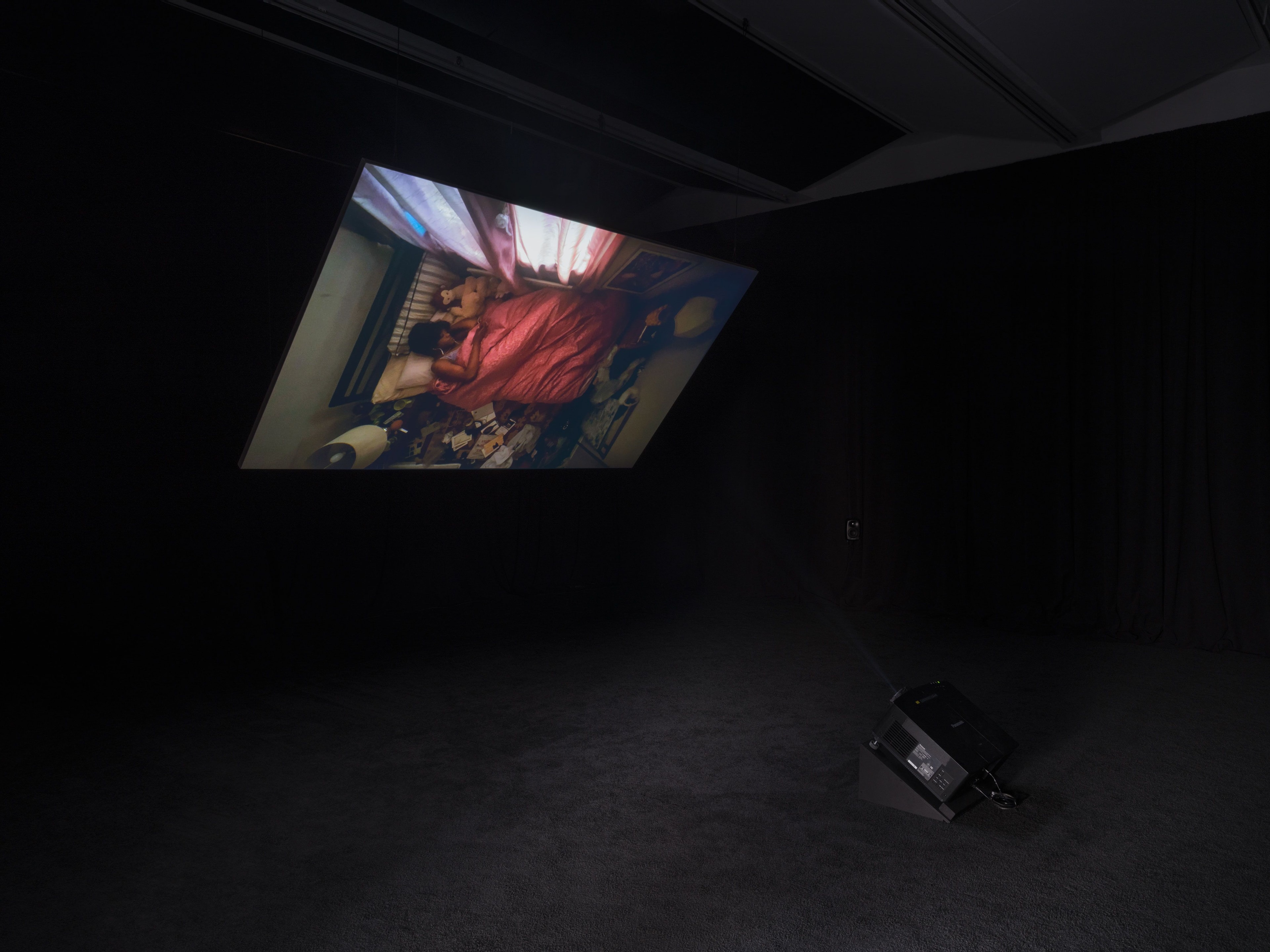
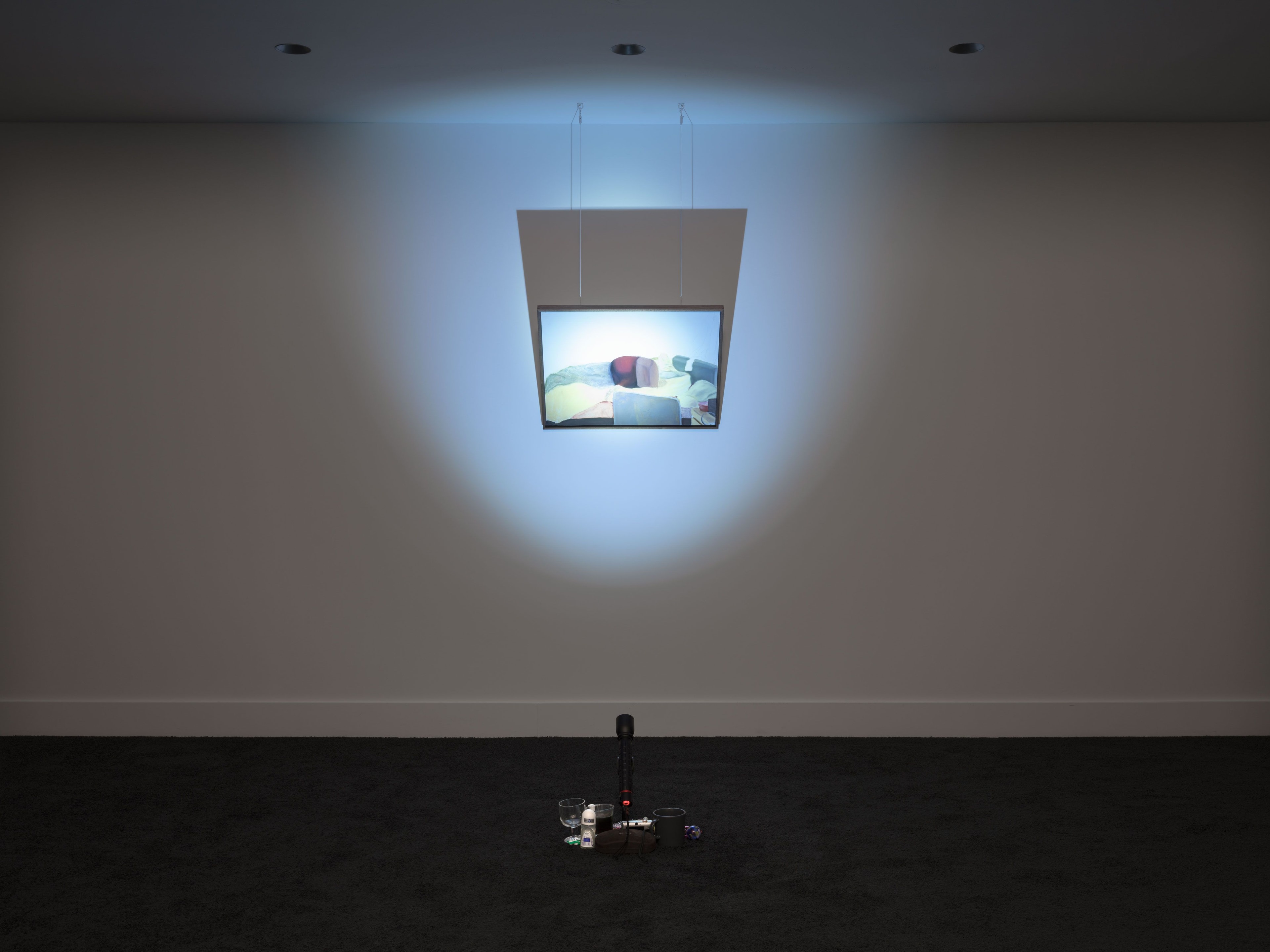
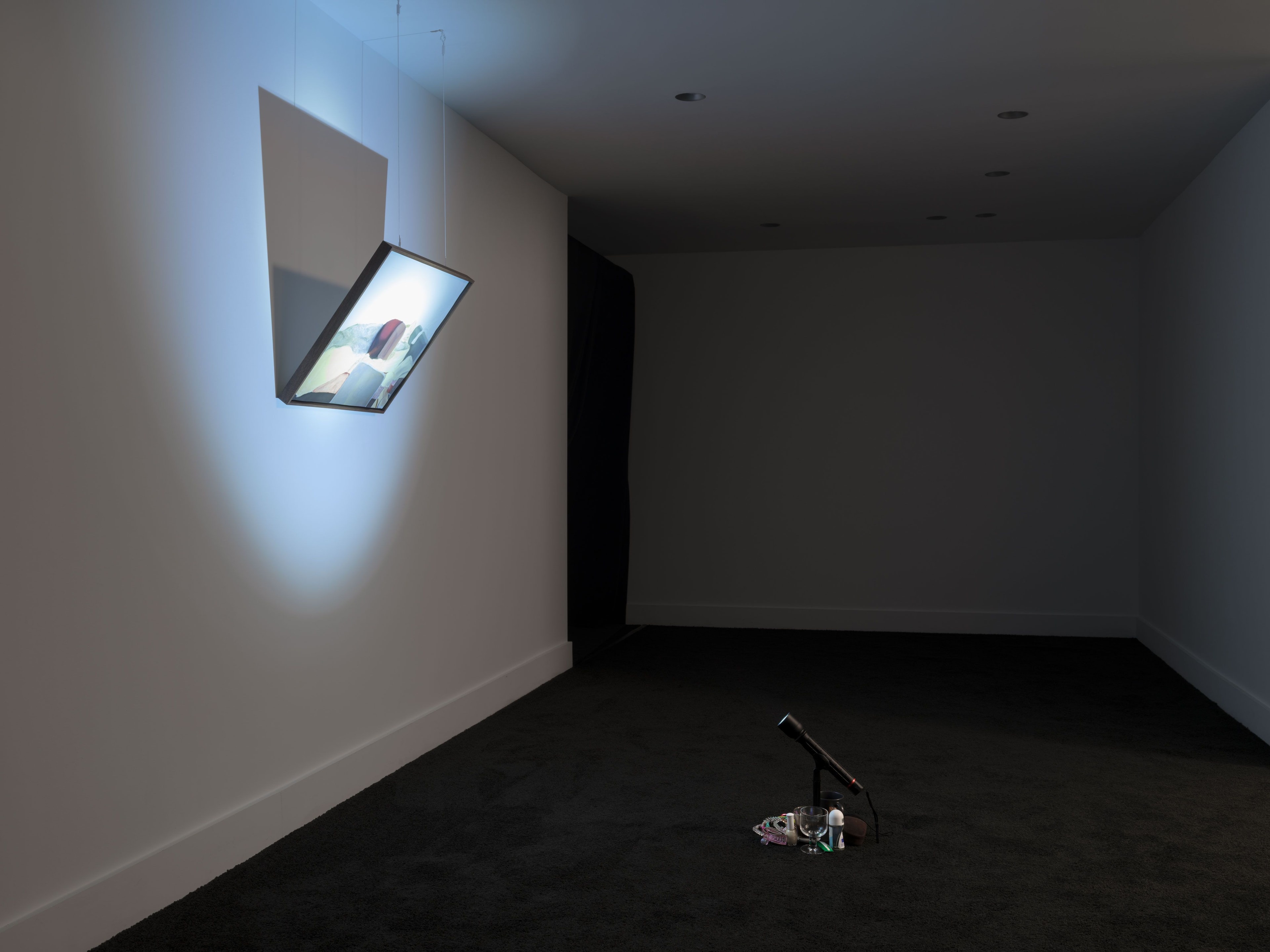
LK: Earlier you mentioned choreographing the viewer’s position or orientation to the image. Could you talk about the black-curtained room, which holds your work Versus (2026)? On one side of the curtain, your film Rhythmic Stimming (2025) plays on a massive screen tilted down to the audience, and on the opposite, a collection of objects—mascara, nail polish, coffee, among others—seems to be projecting onto a painting.
JP: I wanted to have an unwritten contract between me and the spectator, where the spectator has to contribute in some way. Rhythmic Stimming is a durational performance piece where I’m dancing in my bedroom for 20 minutes. I love structural film because it doesn’t entertain. With TikTok edits, everything’s been edited into quick, fast dopamine hits. That editing is cool, but it comes with a sense of passivity. Our brains are learning or creating neural pathways to be like, “Oh, this type of editing is going to elicit this emotion.” In structural film, it forces you to question your subjectivity. Especially in this time now, politically, to watch a Black woman dance in her bed for no other reason, I think is sick. Yeah, it’s cool. [laughs]
With that room, I wanted the screen to be at a 50-degree angle to feel like it’s invading your personal space as a spectator lying down and having something bigger than you. The title Versus comes from it being me ‘versus’ the music in the dancing. It’s like, “At what point am I going to give into chasing the dragon of certain rhythmic beats in the stimming?” It’s also framing the screen against the small projector, and the video against the audience. There's a battle, a versus. The song, ‘Alienz vs Monsterz’ by TellaX is a battle clash song used for dance battles and competitions.
On the flip side of the curtains, the painting of me in my bed and the objects are the material inverse. That installation is a continuation of my previous show at Carlos/Ishikawa ‘United Kingdom London. Portrait O.A.Y.G.’ (2025), where I was looking into Schrodinger’s cat theory, which, in a nutshell, proves a quantum physics hypothesis called superposition. The theory is that if you put a cat in a box and a radioactive agent that has a 50% chance of going off, and you close the box, is that cat dead or is it alive? Because you don’t know, it’s in both states. I was thinking about that in relation to bedrooms in an existential way. In the bedroom, your walls know you more than anybody else. Your objects are a reflection of self. When somebody is alone, and they’re so well attuned to wanting to be something for someone, and they don’t know how to be that for themselves, are they dead or are they alive? Do they give shape to themselves when no one is watching? It mirrors the bedroom in Rhythmic Stimming. Now, it’s a person not taking form in their bed, the flashlight is the projector, and the objects are like the audience. In my mind, If I were to take away the curtains and see the whole thing, it would be the perfect translation of the same thing.
LK: That mirroring also happens in the last installation of the exhibition, where we’re looking down at what you’ve called a well.
JP: I wanted to create a massive, scary well sculpture that looked like it was being erected from the ground. When I think of wells, I imagine myself with a penny, flipping my coin into the water and wishing for something better. For the work, I want it to have an anticlimactic-ness, where there’s no kind of payout; an anti-fable.
The first section in the video is a house party where you move through a room collecting information from people, only to be by yourself and saying things to yourself. In the other part, you are observing a girlfriend and a boyfriend, and the girlfriend wants the boyfriend to stay, but she wants him to leave. There’s the indecision of desiring independence but not obtaining it, and not being able to trust yourself in either reality, like not knowing what to say or wanting to be alone.
With my previous films, shit was way too real. I wanted to project a reality onto somebody else with the well sculpture, not necessarily for it to be a commentary on other people, but to reflect a reality and involve the person watching it on my terms. When the piece was first shown at Carlos/Ishikawa ‘Through my fault’ in 2023, the space was very bright, so you could see a reflection when you looked down into the well. So you were involved in the work by force aha. This also exaggerated because it was shot on spy glasses. In the same way, if you get close to the light in the painting Me in bed 2 (2025), in the Versus room, your shadow is imprinted. This inability for someone to commit shape in their own space has something to do with the shadows that exist outside of that room.
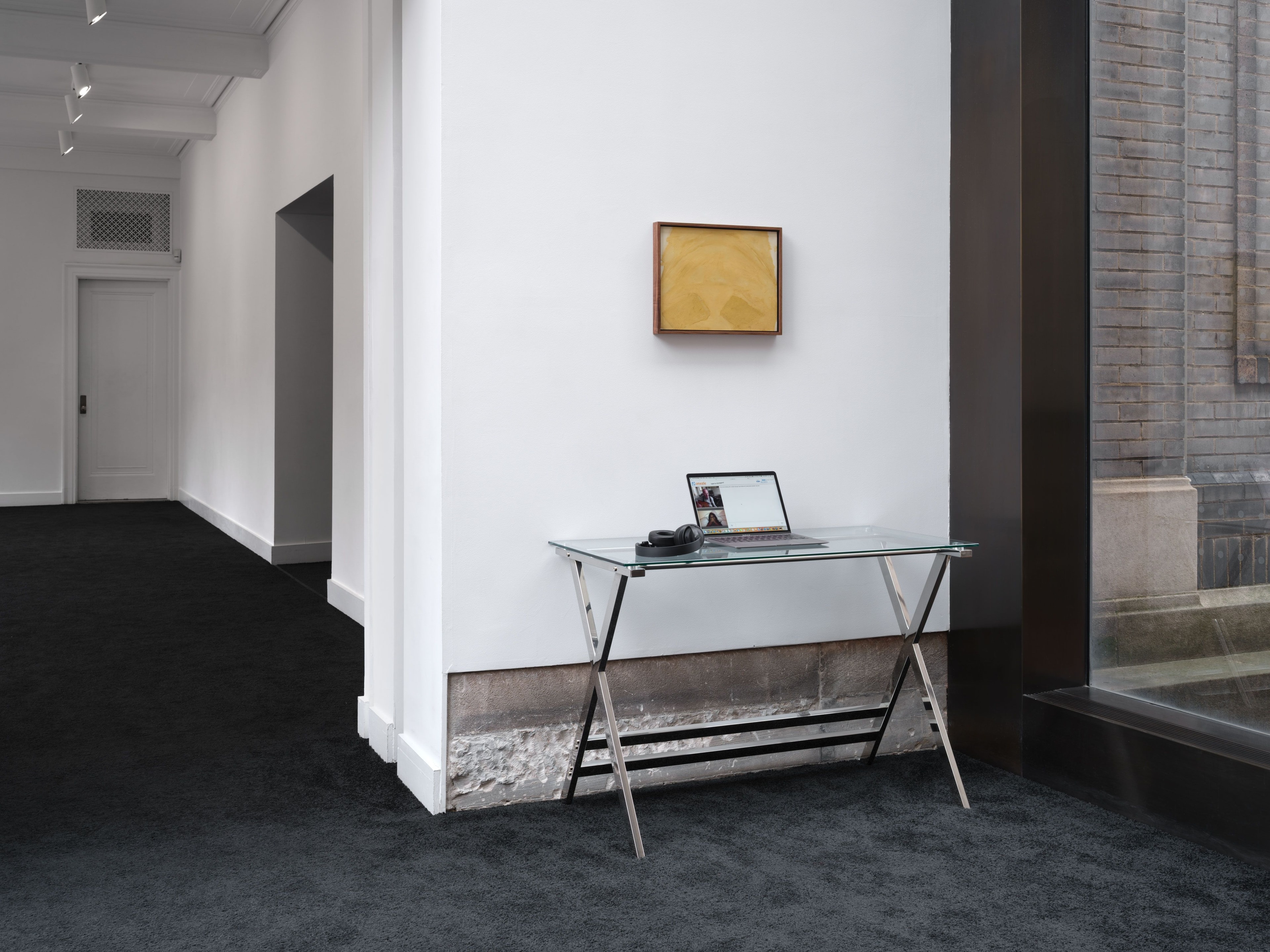
LK: In your work, sound and image are often asynchronous. Sometimes the image will freeze and the sound continues on. It’s reminiscent of a film cutting and the music continuing on beyond the supposed fixity of an image’s truth power, or even between sets at a concert, where the music keeps rolling.
JP: My relationship to film has changed, and it’s crazy how much of it used to be passive viewing in terms of not questioning why I feel certain things when I’m seeing them. As I’ve gotten older, I’ve wanted everything to be completely stripped back. I love Wavelength (1967) by Michael Snow because I can pour so much into it. I can allow my creativity and sense of discovery to question what’s happening and why I’m feeling what I am all in one real transcendental act of viewing. Disturbance and boredom allows for that. Whether it be in terms of looking down a well, shaking your head to try and find the next video, or lying down—these are all modes to create disturbance.
With Pingey, every five years, I make a re-edit because my relationship to film or myself and my dad will continue to change. Film can be so damning in its time-basedness. When there’s a credit, when there’s a cut, you assume that everything is locked in time. So it’s like, “How do you pay homage to that fixity and finality with a re-edit?” The next time I show that work, if I ever do, it’ll be the size of a button because the older I get, it’s more difficult for me to watch. Returning to the films I made when I started at 18 feels a bit like a humiliation ritual, like going onto Facebook 10 years later, because I’m so aware of what I was trying to do or what I was trying to obtain with film.
I always say that if I could say in words how I feel, I would, but the only way I can is visually. It’s such a naive quest and so fundamentally human. Everybody at the core just wants to love and give love. Any child will always pick conformity over authenticity in pursuit of that. Looking back on my work, it’s a way of first meeting yourself and then naively always wanting to be seen through that and be like, “Can you see my point of view?” It’s a place for you to meet yourself.
LK: Chantal Akerman has said in an interview that in the time of structural film, we feel our existence. I felt that intensively in your work.
JP: Wow, thank you so much, I really love her work. It’s true, stillness is so scary. Everything is so immediate in our hustle culture, things are happening so quickly and videos are getting shorter, and with structural film, you feel the passing time of a second. I think being comfortable with feeling the weight of the second passing is probably, for me, the most meaningful because I’m scared of myself in that moment.
LK: John Akomfrah has spoken about what he calls “sonic ways of knowing.” He stressed the significance of sound as a form of knowledge as much as any other, and he’s said that sounds suggest directions for images for him. He spoke about a potent early memory of listening to Arvo Part and feeling as if the music was telling him, “You’re in this space, and it’s possible to occupy the space differently.” Because of how sound has influenced your life and your work, I’m curious how sound has suggested directions for images in your work or changed your sense of self in space.
JP: Oh, a thousand percent. I started making videos purely because of music. Music opens the door for you to meet yourself. When I was younger, I was obsessed with choreography. I’d watch hip hop choreography on YouTube and learn how to dance and learn choreography. I was really interested in when one person would do one thing, why would that elicit that emotion for me? I wanted to edit the way choreographers I was watching were dancing because editing is a form of dance. There are holds, beats, offbeats, and half beats.
You could be the most well read, well whatever the fuck in art, and also not know anything to do with art. But when you listen to something, you know how you feel. Some people don’t know how they feel sometimes, but the only things I know are my experience of my life and how I feel about things.
Credits
- Text: LILY KWAK