Inside Candela Capitán’s Spa of the Near Future
|KAROL CHMIELEWSKI
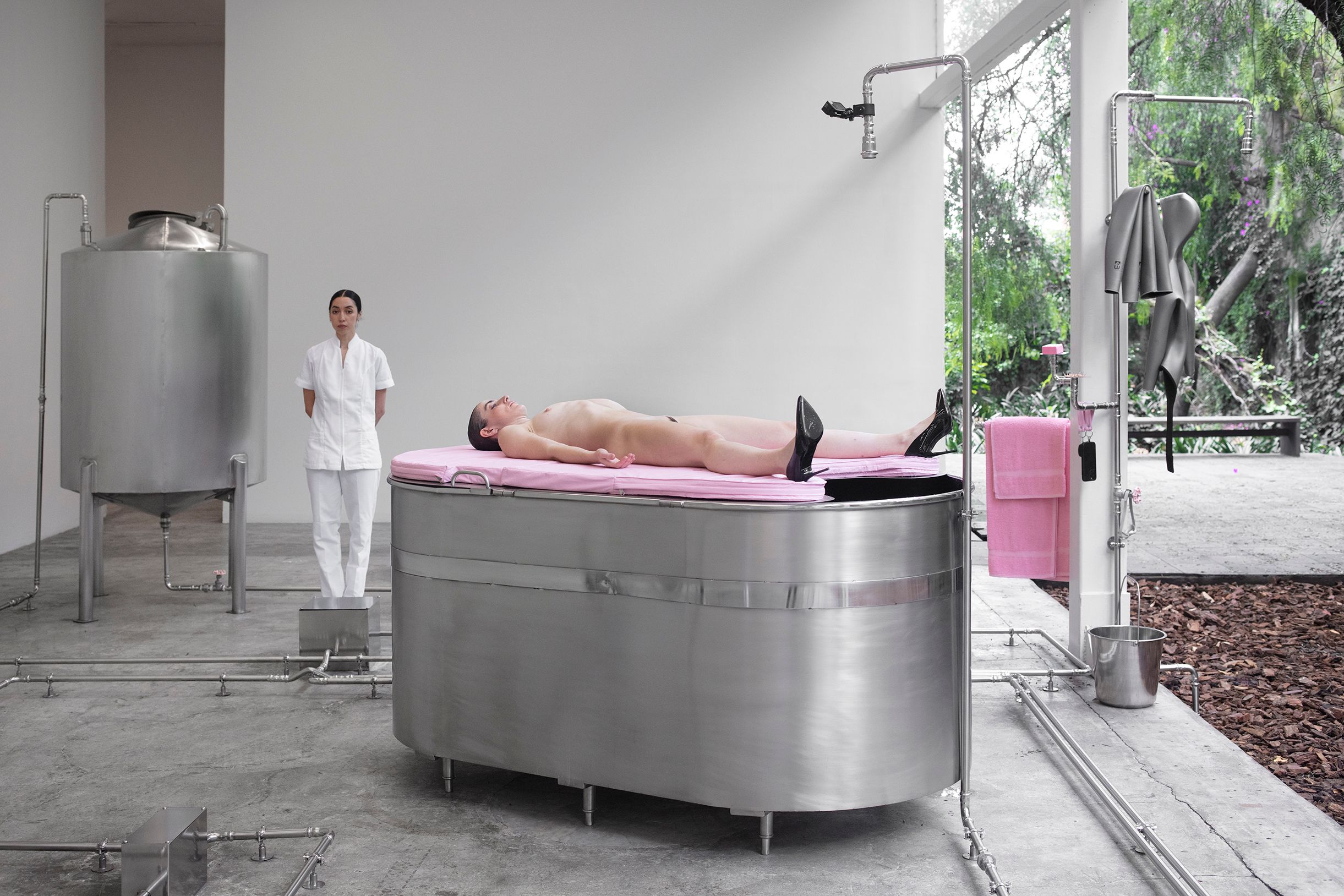
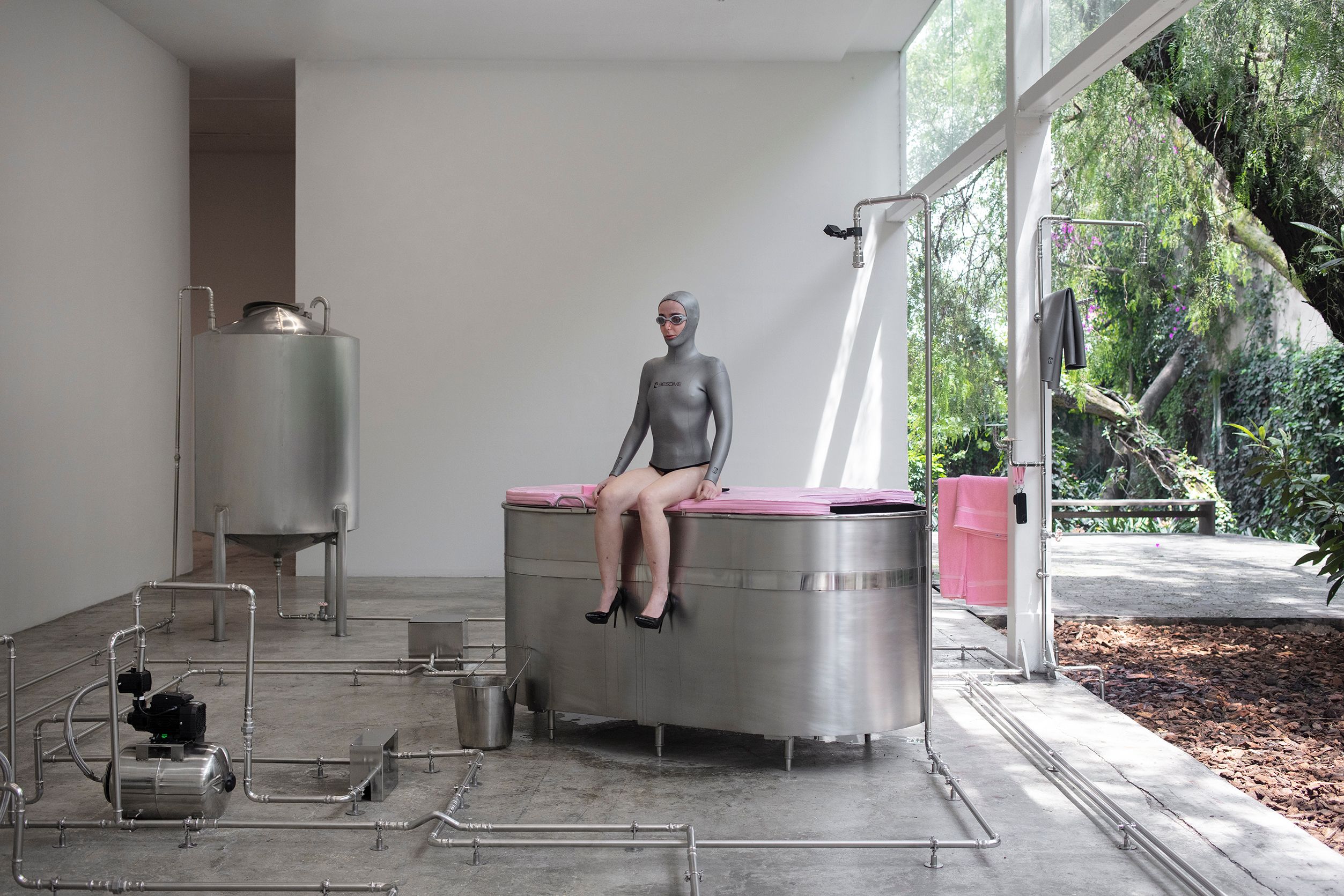
Candela Capitán is a choreographer whose practice has spent the better part of a decade staging the female body under surveillance, exhaustion, and control—livestreamed, repeated to collapse, watched watching itself. For “APNEA,” her first solo exhibition in Mexico, she has turned Galería LABOR into a functioning hydraulic environment of water, pipes, pumps, and a bathtub: a “spa of the near future” activated by a performance that transforms the space into a circuit for practicing the difficult art of holding one's breath. Drawing on ideas of optimization, care, and the body's relationship to alarm, it asks what happens when we learn not to silence the urgent signals of exhaustion and anxiety, but to remain inside them a little longer. Our limits, it suggests, may not lie exactly where we have been told they are. In conversation with Karol Chmielewski, Capitán discusses the exposed infrastructure of the piece, what she calls “negative agency,” and the systems we willingly enter.
Karol Chmielewski: Walk me through the hydraulic system—tank, pressure group, purification, bathtub. Is the pipework meant to read as functional, or does it also become a kind of exposed nervous system?
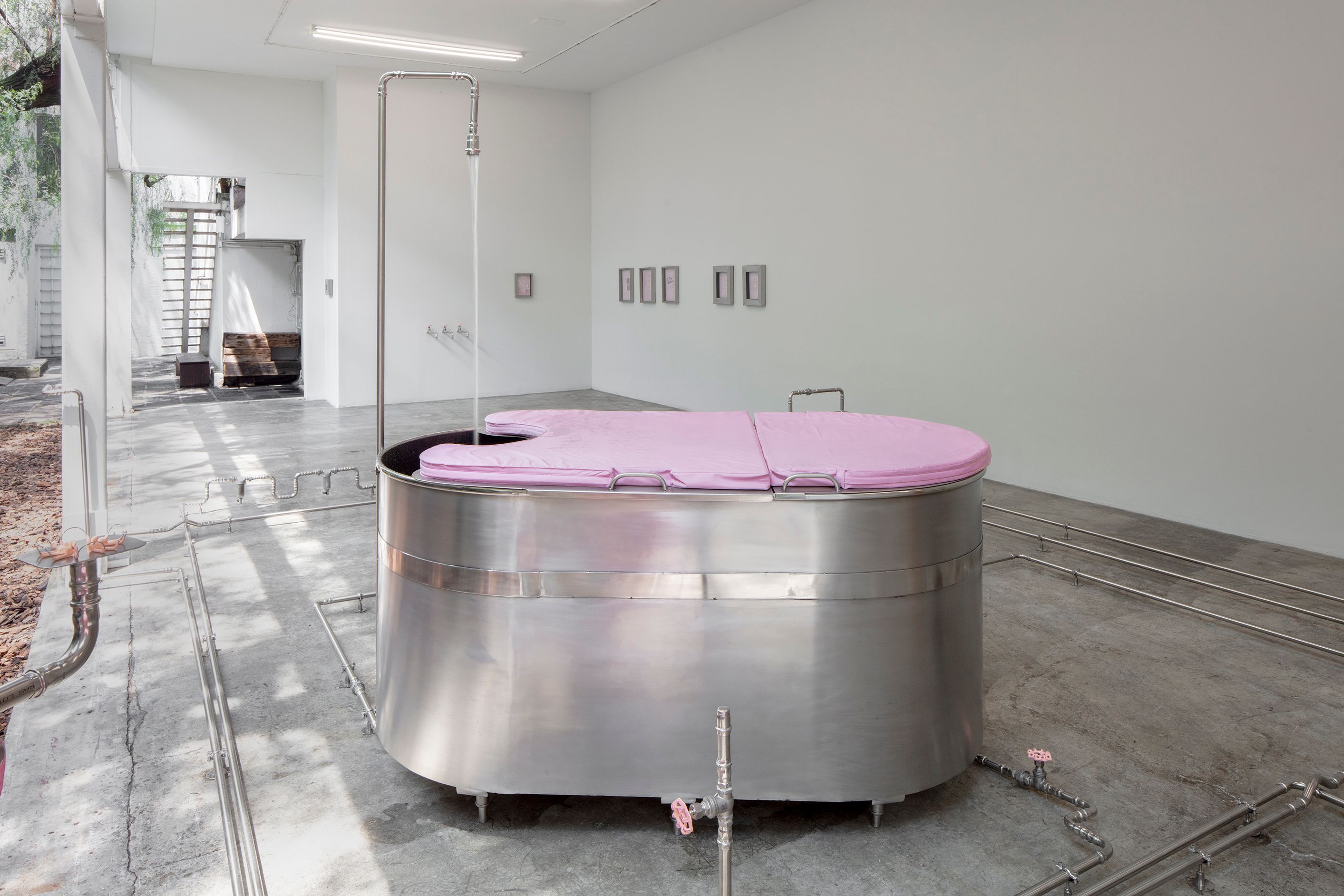
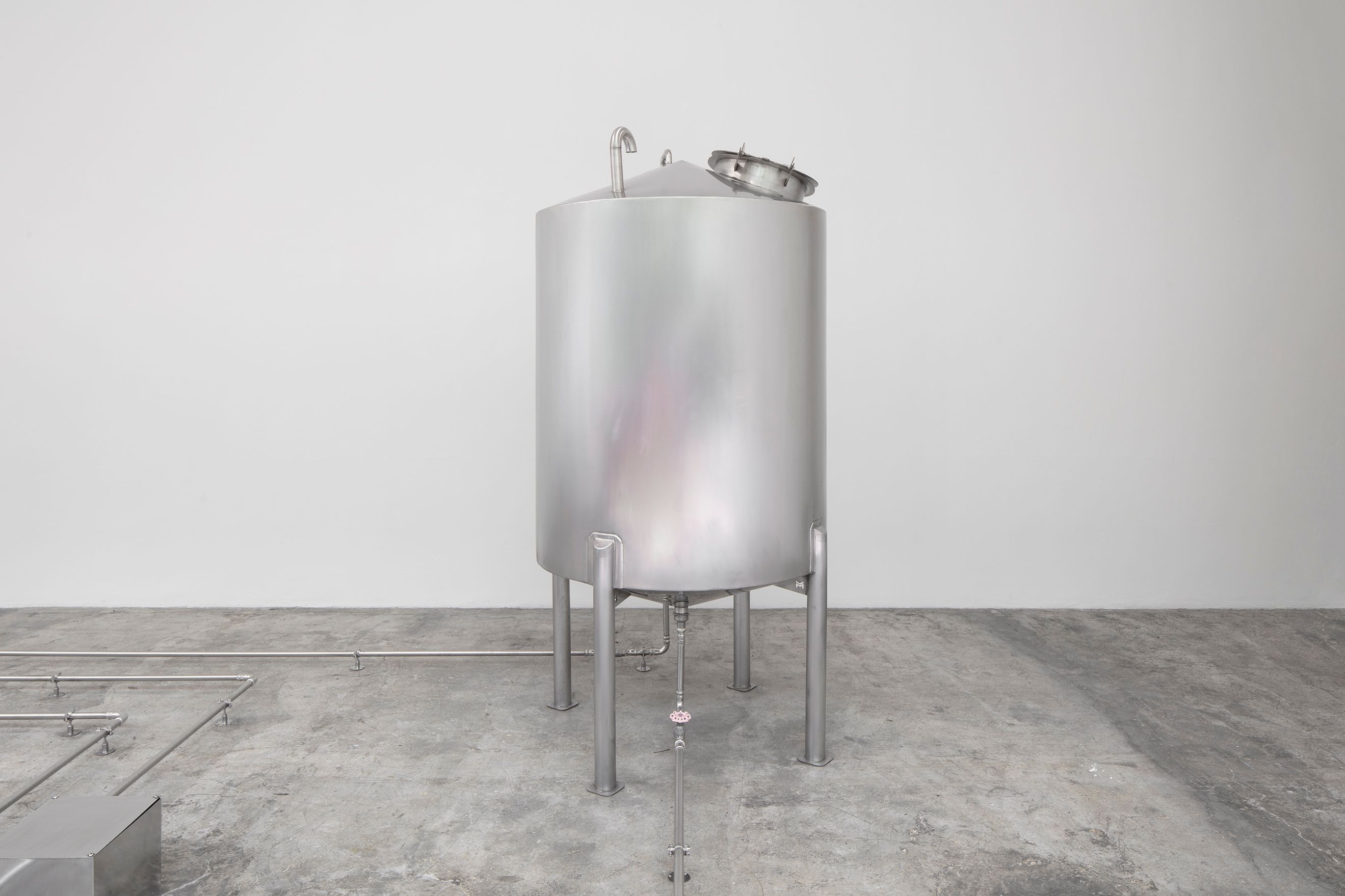
Candela Capitán: The system is designed to make the relationship between the body and the machine visible. For me, the installation is a body in itself: the pumps function like a heart, the pipes like veins, the water like the substance that circulates through and keeps the whole structure alive.
I usually leave the technical elements in my work visible. I’m interested in exposing the infrastructure because the systems that sustain us usually remain hidden. The pipes are completely functional, but they also create an anatomical image—a machine that, once exposed, inevitably begins to resemble a body. And once a body enters that structure, it becomes difficult to tell where one ends and the other begins.
KC: You call it a “spa of the near future.” What makes it near future rather than science fiction? Which parts of “APNEA” are already fully present in contemporary life?
CC: I feel that science fiction has already arrived in our lives. Everything in “APNEA” is already here—imposed forms of care, the pressure to improve ourselves, the body becoming completely integrated into technological environments, and by choice.
That’s why I say near future, not science fiction. I’m making visible a structure that’s already operating around us. What interests me most is that there’s no clear struggle against it anymore. The body participates. It adapts. It gives itself over completely. It’s immersed, it chooses to be there, and it even understands that as a form of well-being.
KC: Where did your fascination with static apnea begin? What was it about holding your breath while remaining completely still that opened up this work for you?
CC: I knew very little about apnea before this project. I came across it while researching wellness and methods of training or regulating the body, and found Camila Jaber’s videos online. She’s a Mexican freediving champion who works mainly with depth disciplines and explains what happens to the body during apnea in a very beautiful, accessible way. That was my entry point. And, unexpectedly, she came to experience the performance herself during one of the first days of the exhibition.
What fascinated me about static apnea is that, despite being considered a sport, almost everything happens internally. From the outside the body barely moves: you are simply there, completely still, holding your breath. Inside, a very intense negotiation is taking place between mind and body. You relax as much as possible so the body consumes as little oxygen as possible, and then contractions begin and the mind produces a very strong urge to breathe. That moment is what interests me: the sensation of having reached a limit doesn’t necessarily mean the body has actually reached it. There is a distance between what the mind interprets as an emergency and what the body is still capable of doing.
For me, that makes it a deeply meditative practice, a conversation with your own physiology, but also with fear, control, and the perception of your limits. And there’s a contradiction I find very beautiful: by temporarily suspending something as automatic as breathing, you become extremely aware of it. You bring the body towards the limit of breath in order to discover the capacity of breathing itself.
KC: “APNEA” appears to criticize the contemporary imperative to optimize ourselves, but doesn’t the performance also ask the body to become better at something? To hold its breath longer, endure more, control itself more precisely?
CC: “APNEA” doesn’t try to escape optimization—it tries to make it visible. The spa is precisely a place where the body is trained: holding the breath longer, enduring more, controlling itself more effectively, becoming more capable.
The critique comes from exposing that process rather than proposing an alternative. I’m not interested in offering a solution or imagining a position outside of it. I want to show how deeply we’re already involved.
KC: “APNEA” is a physiological condition, but you’ve said the word also sounds like a woman’s name. Did you start imagining Apnea as a female character or persona while making the work?
CC: Apnea is the complete cessation of breathing. But within the work, for me, it means several things at once: a state of anxiety produced by constant agitation, the practice carried out in this imaginary spa where the limits of the body are pushed further, and—little by little—a female figure.
There’s something almost playful in imagining Apnea as a proper name. She doesn’t have a specific identity. She exists as a body shaped by discipline, demand, and the pressure to improve. And she’s female because many of those pressures fall with particular intensity on feminized bodies.
KC: Were there particular expectations around femininity, beauty, or self-discipline that you were thinking about while making the work?
CC: From the beginning, I tend to imagine my work through the female body—what it means to be a woman today, and how new forms of pressure continue to fall disproportionately on us.
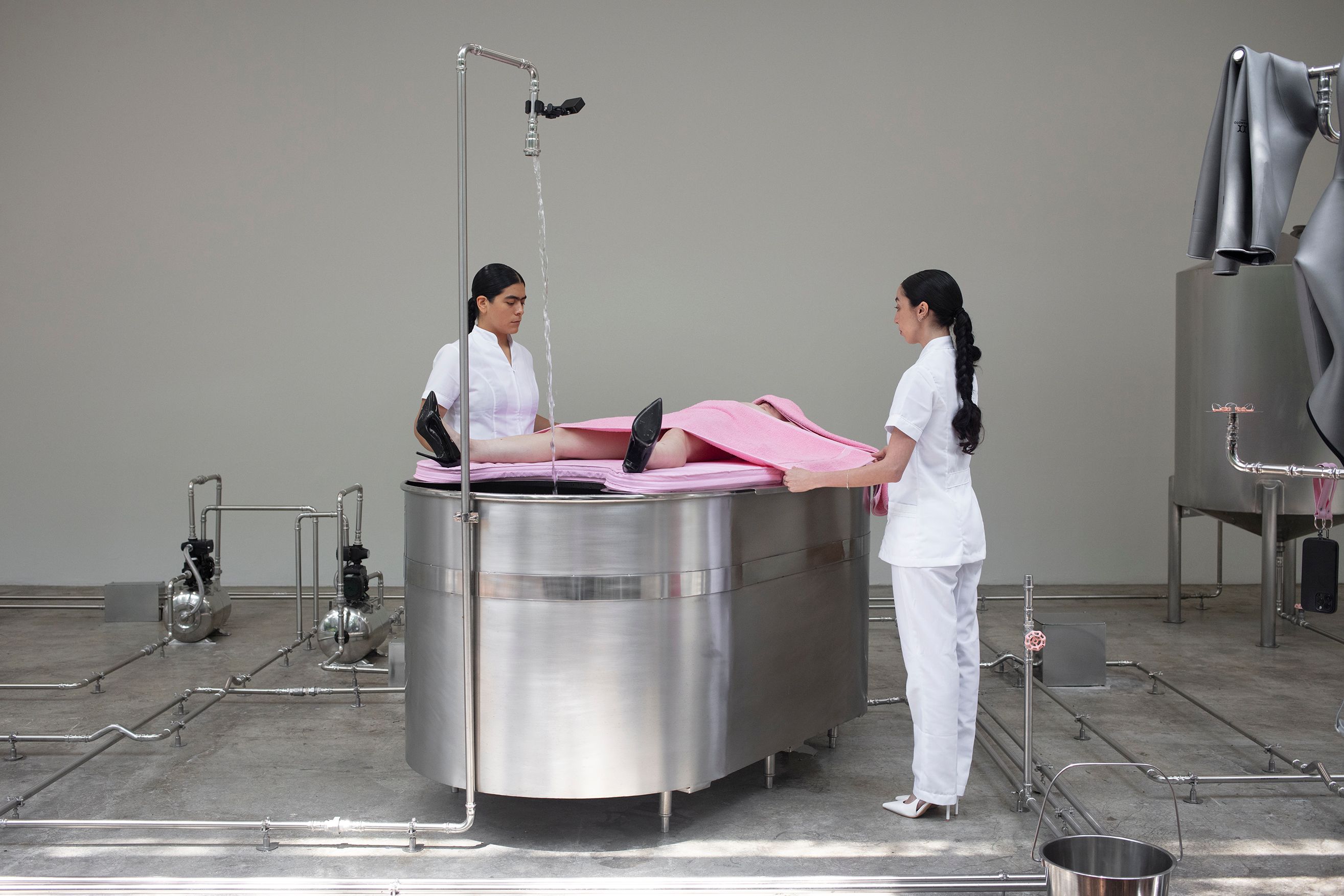
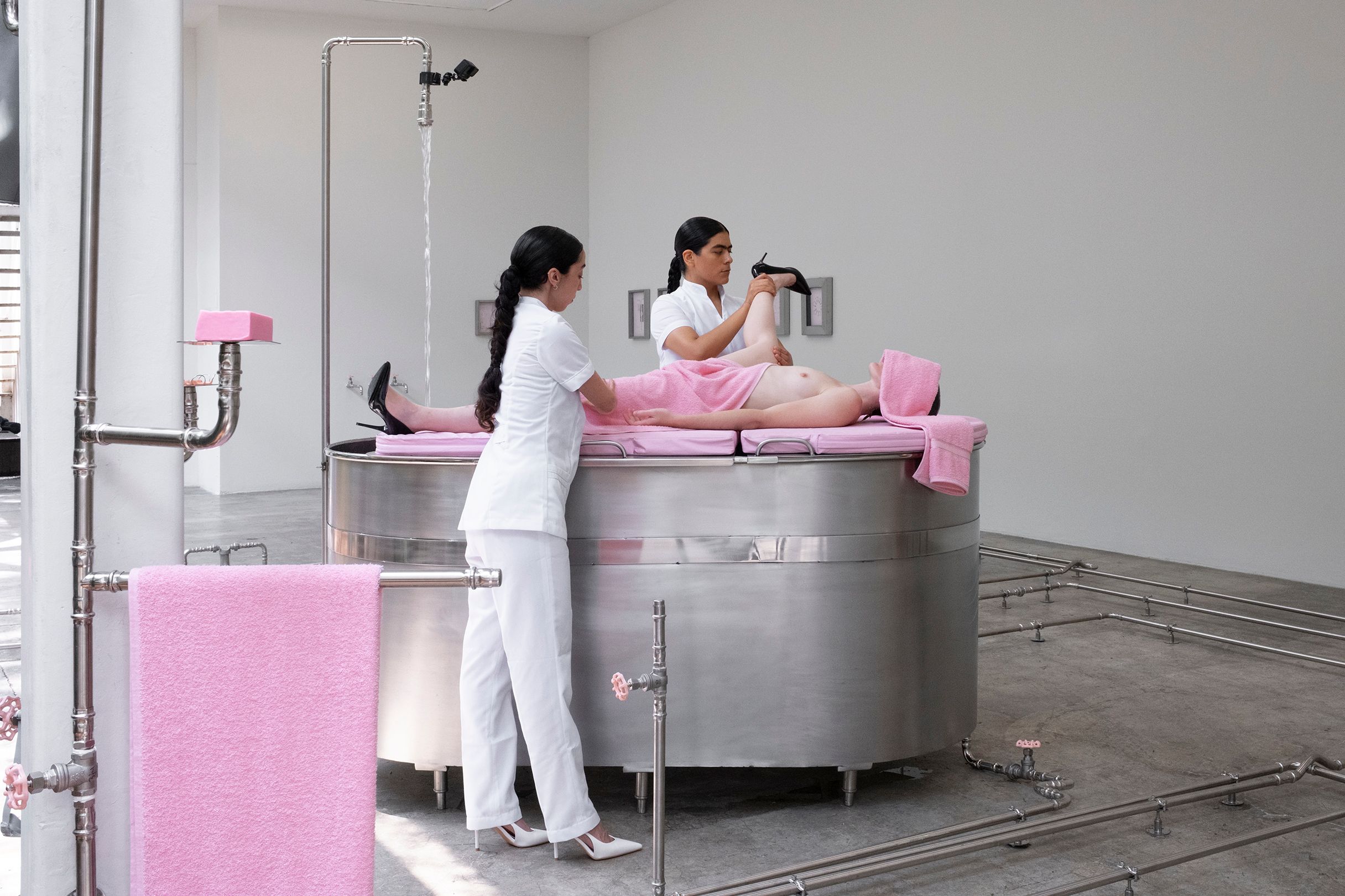
In “SOLAS,” my previous work, I was trying to think through female empowerment. “APNEA” is different. Here, the female body is completely submerged. The “superwoman” Apnea arrives at her trusted spa, where other women perform a treatment on her. Everything appears to come from a place of care, a desire to improve the body, to make it more capable.
But what do we actually mean today by a better body? A body that can endure more? Produce more? Need less rest? And, more importantly, who’s demanding that of us?
I’m not really talking about aesthetic transformation. I think it’s easy to look at the work and immediately think of something like The Substance, but I’m not interested in modifying the body to make it younger or more beautiful. I’m interested in the pressure to become increasingly capable, efficient, and resilient, while at the same time being given technological pacifiers that keep us distracted enough not to fully register what’s happening to us.
KC: This is your first solo exhibition in Mexico. You’ve said the image of violence against women’s bodies carries more weight here than in Europe. What do you mean by that?
CC: I feel that the image of a woman’s body being subjected to violence carries a much stronger weight in Mexico than it does in Europe. Physical violence against women’s bodies feels much more present here, and as a consequence, so does the struggle against it.
In Europe, I often feel that people question my work more, or question the framework through which I speak about violence and the female body. Here, there seems to be much less hesitation around that conversation. When you speak about the violence that occupies and shapes the female body, there is an immediate understanding of what is at stake.
KC: Right before you go under, you’ve got nothing on but the heels. Why leave those on?
CC: The woman Apnea arrives at the spa dressed as a superwoman, and little by little she is transformed into a machine. The attendants prepare her in a very cold way—they manipulate her body, clean her, undress her.
The heels belong to that first image of the superwoman. They’re part of the body she arrives with—an initial construction of femininity, power, and control. But that image gradually disappears. The body leaves behind those codes and is prepared to become something else: a machine-body.
You could think of Almodóvar’s The Skin I Live In—but here it isn’t about transforming a woman into a reproduction of the woman desired by a man. What interests me is that this superwoman arrives seemingly without agency and, little by little, appears to acquire it. But that agency has also been imposed on her.
It’s almost like installing software on a computer. So I think of it as a kind of negative agency, almost the opposite of agency. The body appears to gain autonomy, but in reality it’s being programmed to function better.
KC: For a choreographer, why build a work around a discipline in which movement is almost entirely suspended?
CC: The suspension of movement has been part of my choreographic research for years. I also feel it’s a condition of our reality — isolated bodies, still, connected to different devices.
At the same time, I don’t think movement is cancelled in “APNEA.” It’s constructed through breathing, and through the practice of controlling that breathing. The body appears almost motionless, but internally it’s doing an enormous amount of work. The movement just shifts into something microscopic and controlled.
The same way the machine’s infrastructure is exposed, I’m interested in exposing the body’s infrastructure too—a body practicing a discipline, trying to control and sustain itself, a body that trembles and fails. For me, that’s choreography.
KC: You’ve described another piece as “not escape but a strategy to inhabit the device from within and fracture its logic of consumption”—a “habitable image.” Can you talk a bit more about that? Does it also apply to “APNEA”?
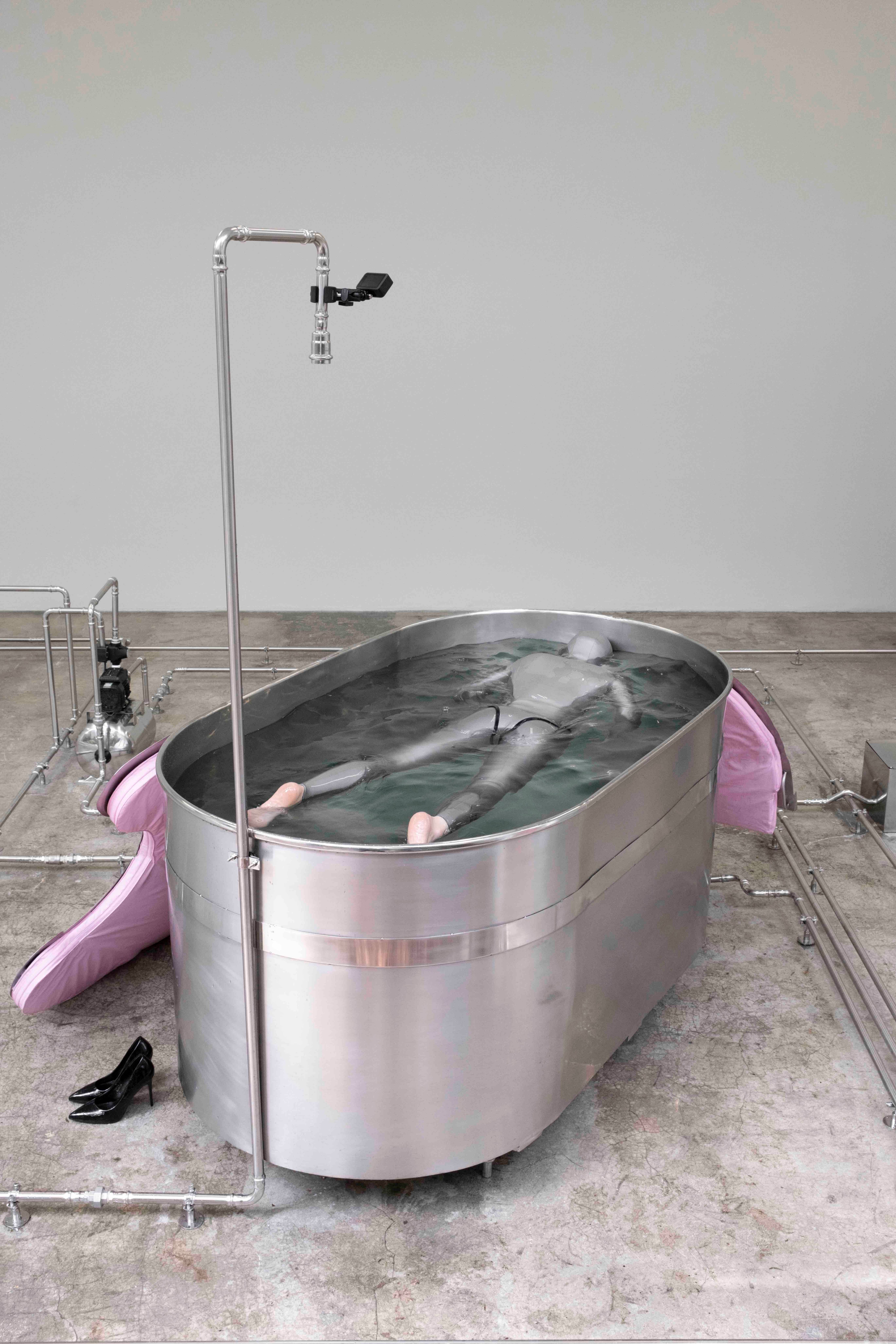
CC: Yes, I think it does. That’s where the idea of an inhabited image emerges for me: an image that isn’t simply made to be observed, but one a body has to remain inside and physically sustain.
And I think that’s precisely what’s interesting here. When a body remains inside these conditions over time, limits and fractures begin to appear. Fatigue, breathing, physical resistance make visible what’s normally kept hidden. It’s a way of pushing the image to the point where it begins to reveal itself.
KC: Has making this piece changed how you think about your own rest?
CC: The truth is I suffer from many of the things I talk about in my work. I’m not outside this society observing it from a distance—I’m completely inside it.
Many of the problems I address are also part of my everyday life, some more than others. I’m addicted to the internet, I put pressure on myself to maintain a certain kind of body, and I’m also addicted to my work and to discipline.
So when I talk about productivity, self-discipline, control, or the inability to rest, I’m also talking about my own body and my own mind.
Credits
- Text: KAROL CHMIELEWSKI