How to Build a Set with Atlas of Shows
|Gigi Nadeau
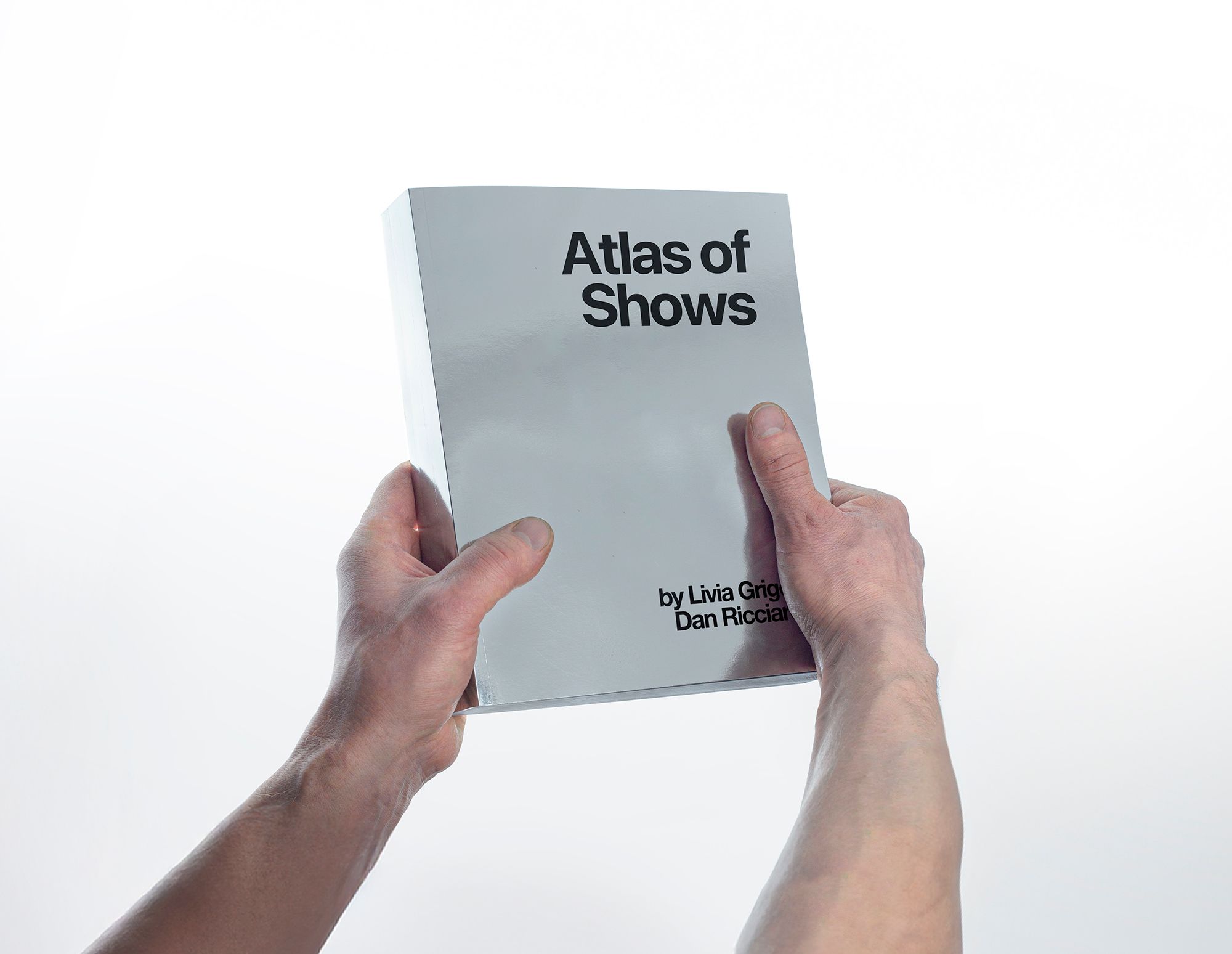
Livia Grigori grew up in early 2000s Moscow, where she spent most of her time in a small courtyard tucked between tall buildings. There, she began staging plays that starred kids from the neighborhood. Casting talents, designing sets, and even fashioning invitations from fallen leaves, Grigori meticulously oversaw every element of these shows.
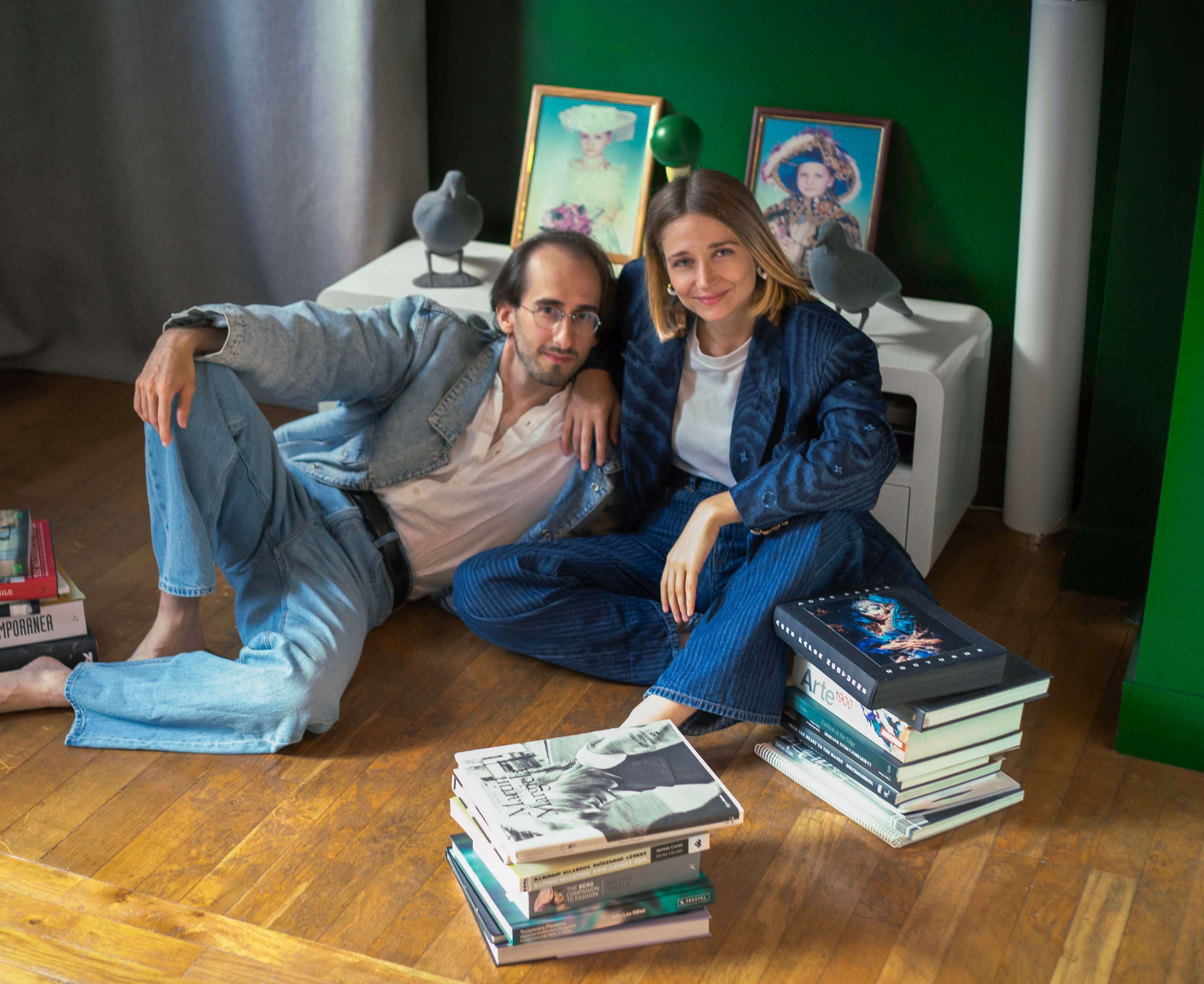
Today, Livia and her partner, Dan Ricciardi, design sets for some of the world’s largest fashion brands. When they’re not helping materialize designers’ imaginations, the two often spend time working on their Instagram account, “Atlas of Shows,” a project that breaks down runways through an architectural lens—unveiling the concepts, infrastructural layers, and individual players behind particular set designs.
In between Paris and Copenhagen Fashion Week, Gigi Nadeau sat down with Grigori and Ricciardi to discuss the architecture world’s perception of runway design and the evolution of set design.
Atlas of Shows video analysis of Courrèges FW25 runway show
GIGI NADEAU: Livia, what came after the plays and performances?
LIVIA GRIGORI: I think those [the plays] were my first real performative ground. When I was a bit older, I continued putting on plays with my friends, which was funny because we were more grown-up then. Then I looked at fashion, but I was not necessarily interested in the clothes. I was interested in the phenomenon of fashion.
Discovering Alexander McQueen and [Hussein] Chalayan was really the “aha moment” for me. Chalayan, especially, has an architectural approach that really reflected our interest and the type of research that we were already doing. Those two designers really made me think, okay, this is something that we could be doing.
GN: And where did it go from there?
LG: I was in my last semester for my master’s in architecture at a very technical university, and I had to choose the subject for my thesis. I didn’t really know what I wanted to do, but I knew what I didn’t want to do—I didn’t want to build a skyscraper, an urban plan, or a landscape. Don’t get me wrong, I love so many architects who do that, and I have a huge admiration for it, but I realized that was just not for me.
One day, Dan backed me into a [metaphorical] corner and said, “Livia, I am giving you until the count of three, and you need to tell me something that you like.” At that point, he was so desperate to get an answer out of me. He counted down from three, then I blurted out, “fashion shows.” I felt so ashamed saying this because, for my teachers, friends, and colleagues, fashion was frivolous and careless—just nonsense. They thought it was something with not much intellectual matter.
Dan stayed silent for a couple of seconds, which to me felt like ages. I thought I’d said something stupid, but in reality, he was thinking about how to make it happen. He was a big fan of OMA and knew that they had been doing fashion shows for Prada for so many years. He suggested we get in touch with the architects. That step really helped us have a real belief in this idea.
DAN RICCIARDI: We didn’t know yet what we were doing. We were just coming at it with curiosity. As architects, we knew our own world, but we also felt that we had this duty to open up our view and perspective to different creative fields. Then, we realized that to make shows, you must master the space; therefore, an architect could do it.
GN: How was a thesis about set designs for runway shows received in a room full of architects?
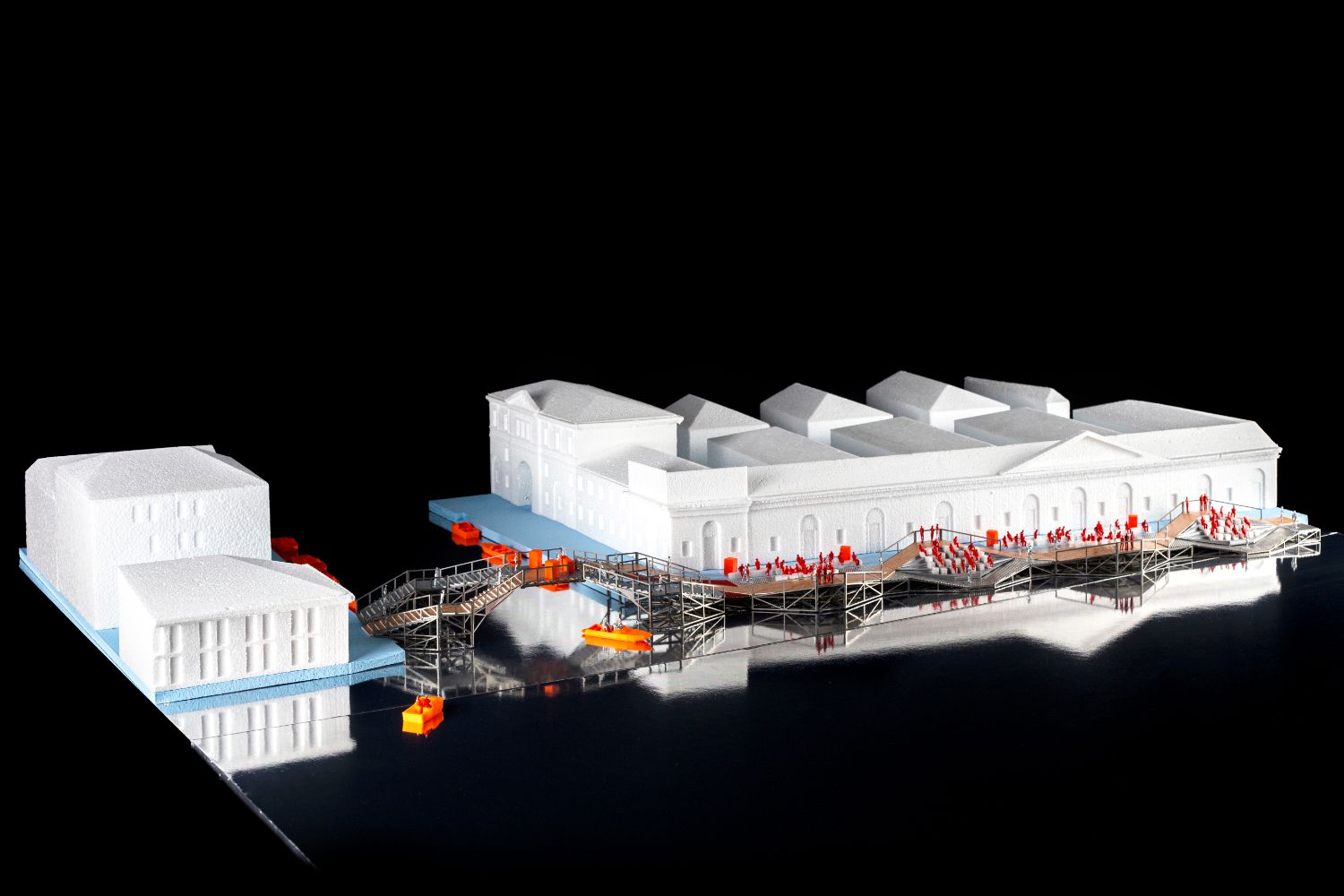
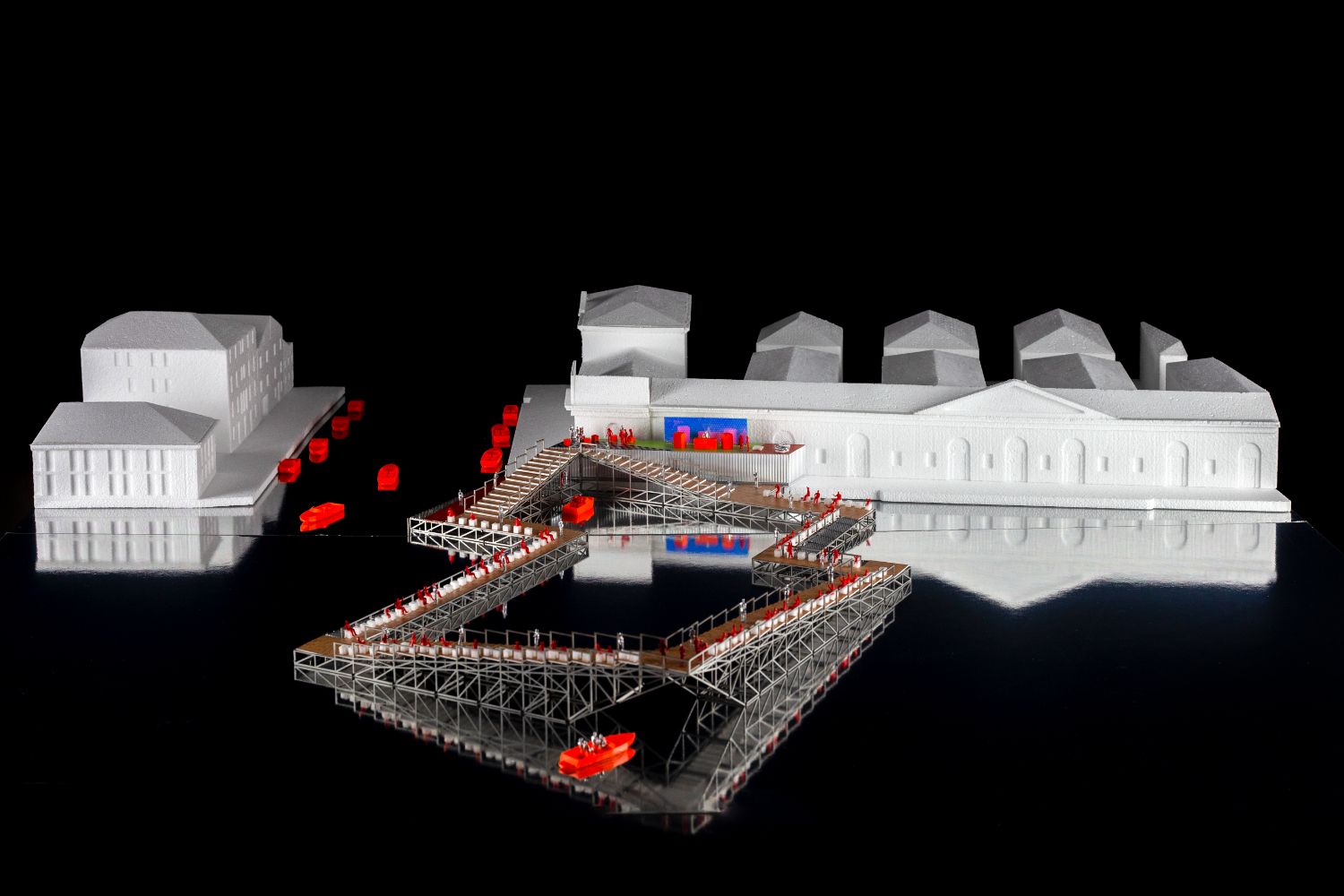
DR: Tackling the topic was an act of faith. We provided a design for a fashion show, but for an architect, that is not architecture. Other people were presenting these big skyscrapers, and we basically came out with a huge book and three architectural models, which were each one meter by one meter.
In the end, the work was so outstanding that we didn’t care if anybody said anything, because this was our project and the start of a possible career. The thesis is the moment in which you are allowed to start your own research, despite anything that anybody says to you. So, we went straight through on our path. We decided what to do, we didn’t listen to anything or anybody. The reception was actually mind-blowing. They appreciated it even though it was out of their professional expertise.
GN: Can you run me through the step-by-step process of a set design?
LG: Someone from a brand comes up to you and says that they need a set design for a fashion show to host X amount of people—it starts from there, with a conversation. Then, how it looks is determined by choosing the venue. We ask, will it be in an industrial building? An institutional building? A museum? That shapes the identity of the show and plays a huge role in deciding what the set design will be.
From there, you create a relationship with the client. There are different kinds of clients: those who already have the complete idea, those who have some loose inspiration, and those who’d like to receive full creative inputs. The job of a set designer is to give spatial form and conceptual depth to their ideas through a dialogue. The set designer proposes different options and variations until something resonates, and reflects the creative intention of the client.
From there on, there are the canonical steps for validating project designs, sketches, seating plans, creative plans, and mood boards. Depending on the complexity of the project, you might also work with materiality—sometimes, we might even invent materials. There is also the dismantling of a fashion show, which, funnily enough, has to be planned, too.
GN: What is the most satisfying part of the process?
DR: I really like the early phases in general, when you have to develop the concept, drawing from your own pocket of culture, movies, literature, art, and so on—the moments when you start the world building process. There is this sort of cross-contamination between your own idea and the idea of the client, which is a very beautiful exchange.
LG: I share this, but I also love it when the show is done, when the clients are happy and the guests have had fun. It’s a special moment. After the pre-show adrenaline rush, there is catharsis when you see everything done and accomplished, when everyone backstage is clapping and shouting in happiness.
GN: You two have, in many ways, paved the way for yourselves—combining your architectural backgrounds and implementing them into fashion. How did you branch off from traditional architecture roles and navigate into this territory?
LG: We knew nothing, so we bought a ton of books about fashion. At one point, after reading so much, we felt that, though it was all very interesting, it [the material] was also misleading. It was too focused on the garments, and being architects, we felt the lack of information about space and architecture in fashion shows.
DR: We then decided to fill the voids ourselves, to analyze the set designs and build up the information we were looking for.
LG: We created a super long Excel file with all the fashion shows that we could find images of online. Then, we started to select and categorize them into, say, indoor vs. outdoor shows. From there, we had the idea to make a book, which then became the thesis: Fifteen Minutes: The Atlas of Shows (2020) [“Fifteen” because that was the average duration of a fashion show].
The book contained 70 shows among the most significant in the history of fashion. And we re-drew every single set design by ourselves. We didn’t have any plans or drawings to reference. We would count by head how many guests were seated in the first row and how many steps the model walked, and we would map it out in our bedroom to figure out the count in meters.
DR: The idea was to understand how the space felt.
LG: It was Dan’s idea to interview people who actually work behind the scenes. He said, “Why not talk to production managers, set designers, choreographers, musicians, even technical directors?” The amount of professionals who work behind the scenes is immense. Realizing that was a moment of revelation for us.
GN: Do you think fashion will ever go back to embracing raw, unpolished set designs, or do you think we will keep moving forward with bigger, more polished sets?
LG: Nowadays, we have the technical capacity, resources, materials, information—everything—to be able to do crazy fashion shows at a massive scale. But sometimes the bravery for raw creativity lacks. In the past, it was more genuine. The backstage was crazy and a bit insane. Everything was wild, but the creativity was strong.
I don’t mind using the resources that we have today, but think that we can be a bit stronger creatively, and more challenging, too—because fashion is not only about safe and positive concepts.
DR: Look at movies from the 90s, for example, or from independent movie makers. Their rawness may come from a lack of budget, but that rawness is often balanced by the creative burst. It [the rawness] was partially because of a trend and partially because of resources.
It is a complex question that swings between a brand’s image, financial position, and public perception. We live in a world where being polished is the safe expression of the moment. Trends change, and visual languages as well, so we’ll see!
Credits
- Text: Gigi Nadeau