Clara La San & Jam City: Good Mourning
|Rianne Akindele
For Clara La San, preparing for what’s next is less about reinvention and more about staying put. Over the past year, she’s been traveling constantly, back and forth to the US for shows, rehearsals, and studio time. Now, feeling pulled toward familiarity, working, and stillness, the British musician is building out a home studio in the UK. “I love going to the same places,” she says. “It sounds boring, but I love going for a walk down the river. I don’t really like change of scenery.”
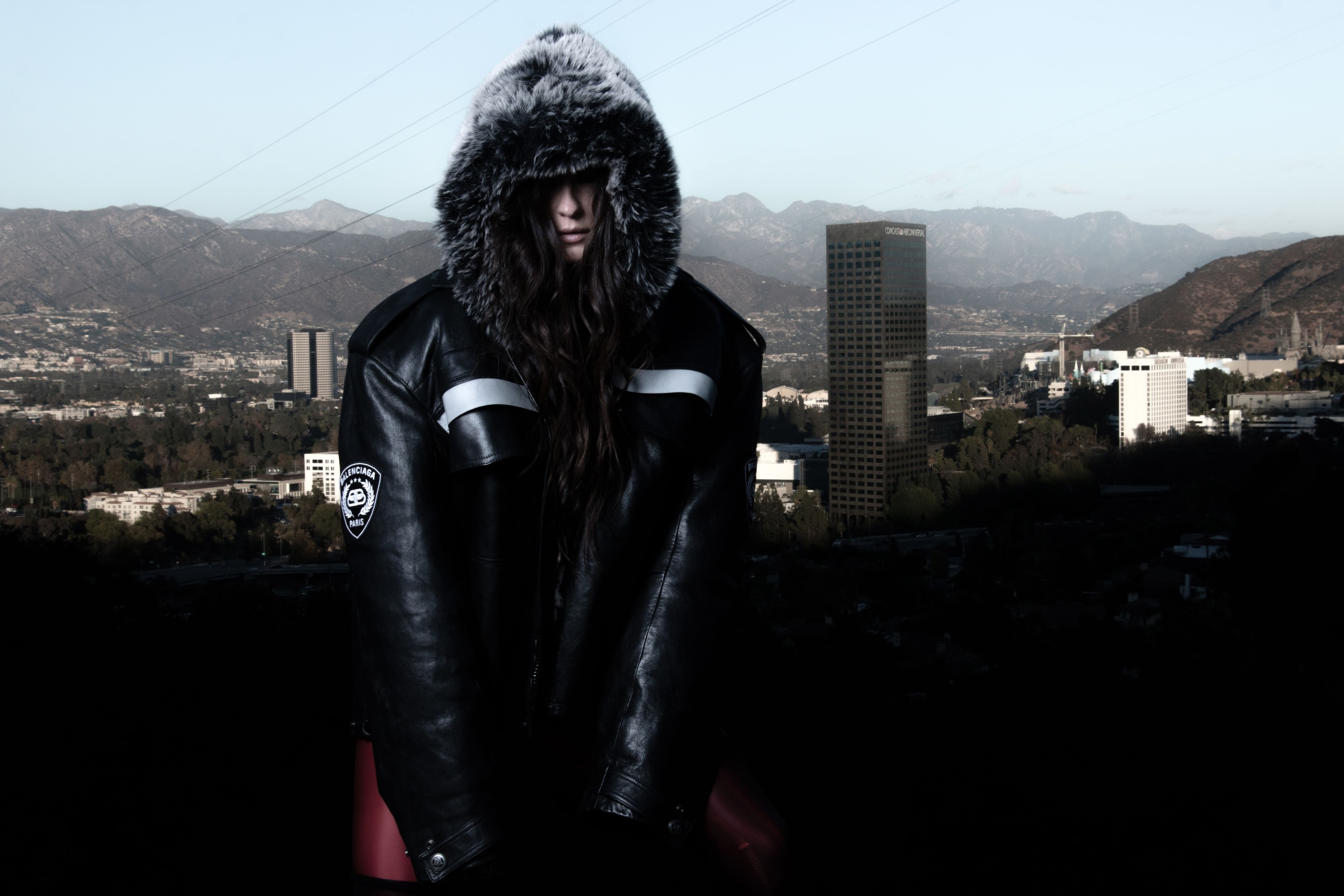
When I join the Zoom call with Clara La San and her close friend and longtime collaborator Jack Latham, the British producer whose sleek, nocturnal electro-pop sound contoured the early records of Kelela and Troye Sivan and pulses through his own project, Jam City, the camera is off. The lack of visual anchor is fitting considering their shared preference for a kind of soft anonymity. Yet over the course of the hour, their ease with one another is also unmistakable, serving as the shorthand for the type of creative partnership that only comes from years of mutual trust, shared taste, and an unspoken understanding of how the other thinks and works.
In early years, their synergy was formed through numerous email exchanges of production notes and files. Both immersed in the spirit of bedroom pop at the time, the duo began working together on La San’s diaristic mixtape Good Mourning (2017) before they had even met in person. Made entirely through remote communication, the project was met with praise upon its release. And yet, just a couple years later, La San pulled it from the internet, a decision the artist still stands by.
During a rare pause amidst the end-of-year chaos, while the rest of London is swept up in a pre-holiday frenzy, I catch the pair mid-flow, hunkered down in the studio. This current weeklong studio stretch, which comes only a year after the release of the re-worked Good Mourning, marks one of the first times the two have worked together in person for consecutive sessions.
Tucked away in their week-long session, with only five days carved out to make music, the two are surprisingly unhurried. “It doesn’t feel like work,” they tell me. Without pressure or clock-watching, the pair simply makes use of the space and freedom to follow ideas wherever they might lead.
CLARA LA SAN: I remember our first session together and you really liking “Run to You.”
JAM CITY: That’s one of my favorites. There’s something in your music, especially those early demos, that feels very pastoral. A lot of those early pieces didn’t have drums, and they felt quite lonely in a really cool way. Windswept. Like being adrift in a big space. I really loved that.
It felt romantic, maybe a little gothic as well. Like an atmospheric film you could just submerge yourself in. At the time, I was like, “Wow, I haven’t really heard anything I’ve connected with on that level.” And I still feel the same. There’s very little that comes through where I’m just like, that’s right in my sweet spot. That’s hitting all my pleasure centers. That’s what I love.
CLARA LA SAN: I think the lack of drums came from a place where I just didn’t know how to approach them, so I would leave drums until last or I wouldn’t include them at all.
That’s become part of the sound, and it would have always been like that. It feels like it was meant to be. Even now, when we’re producing together, we make sure there are sections where we have less drums, or we allow these ambient moments to happen where things can really open up.
JAM CITY: And there’s always an implied sense of groove through the vocals. Clara has such great timing. It’s not just like, “I write great melodies and I don’t really know how to do drums.” Even if drums come later in your process, there’s always that implied rhythm. The vocal sits just offbeat. There’s a pocket.
That’s something I sometimes struggle to explain to other artists, where the pocket should be. But you’ve always understood it. I think it comes from R&B as well. The rhythms are always implied. They always land in the right spot. It’s never just straight on the beat.
CLS: I’ve never really analyzed what we do, but it’s interesting.
RIANNE AKINDELE: When you look back at that period, what does it feel like the project was trying to resolve? Does it fulfill what you sought to accomplish?
CLS: I think what was so nice about the re-release is that we were able to go away and spend time re-recording the vocals. I just thought I could record them better, basically. And the mixes as well. I felt such a connection to those songs that we wrote together that I really wanted to do them justice.
JC: It was years of work.
RA: Take me through it.
JC: If you went into my old email address, you’d just see threads and threads of messages.
CLS: There were different versions of some songs, I remember.
JC: Really different ones. There’s this cliché in music that the first thought is the best thought, that the first thing you put down is instinctual and pure. And sometimes that’s true, and it’s great when it happens. But most of the time, I’ve found that if you keep workshopping something, the chances of it getting worse are actually much slimmer than it getting much better.
With that mixtape, we weren’t even thinking about it consciously. We just enjoyed working on it. It was always like, “Oh, I’ve got a new vocal from today, I can’t wait to drop this in and tweak the beat.” That snowballed over a long period of time, of emailing back and forth, revisiting it, remixing it. And when we finally heard it again, it was just like—
CLS: It felt like we had to release it.
RA: How did you learn to trust that intuition, especially when it went against expectation? How did you know it was right to go back and keep working on it?
CLS: I think it was just passion. Nothing else really came into the equation. You just have to do it because you know it’s right.
JC: Yeah, that’s worth repeating. We’ve both been doing this for a long time. I’m a little older than Clara, but making music is the best thing in the world.
CLS: It’s like a form of escapism.
JC: It’s escapism. It’s therapy. It’s meditation. It’s so much more than the music itself. It’s more than the release campaign. All of that stuff is exciting, and it’s part of it, but the making of music is never time wasted, even if the song never comes out.
Coming back to that mixtape, so much joy went into it, and no one was really watching either of us.
CLS: Working remotely on it was exciting for me. Opening an email and hearing a new version was always such a moment.
One of the many things you’re good at is structuring a song and making sense of it.
JC: And I trust you. If I ever do something you don’t like, I know you’ll tell me. That’s rare. Somehow, we locked that trust in really early. We’re on the same mission, trying to make the work as good as it can be. Everything else is secondary.
RA: How do you balance nostalgia, inspiration, and reimagining?
CLS: I love the 2000s era and R&B from that time. That’s where my favorite music comes from.
When I’m creating new music or focusing on something, I don’t listen to much music at all. I just like to focus on the possibilities of what we can create together.
JC: The older I get, the more I shut down flooded avenues of influence. Not in a negative way. I just don’t need them. I already have a whole sack of influences—2000s, R&B, and everything else. I’ve got too much to get through for the rest of my life.
CLS: When I listen to music, I just go back to what I already love, and that never gets boring for me. When I need inspiration, I sometimes completely disengage and then re-engage again.
JC: I’m still trying to figure out records that are 30 years old or things I heard for the first time as a teenager. I’m still confounded by them. We both keep new music at arm’s length for a reason. The more you do that, the more space it frees up for your own ideas.
CLS: I do feel stuck in my ways sometimes, but I’m not apologetic about it.
JC: And things always come back around. The 2000s resurgence has been happening, and I’m like, great. I stopped paying attention around 2009, so I’m ready. I’ve been listening to rap records from the late 2000s, and they still feel so fresh.
If something like that comes up in a session with Clara, I know that world. I didn’t need to stay locked into everything that came after. One of the good things about getting older is knowing what you like. That fascination never goes away. I’ll still be obsessed with a song from 2009 for the rest of my life.
CLS: I would never want to go back in time or be younger. Everything has led me to where I am now.
RA: What were your first forays into music? Was it going to shows, learning an instrument?
CLS: I studied classical piano and jazz piano for a long time. I started when I was around 11. In high school, I started writing songs on my own. I enjoyed that more.
I found it hard to focus on classical pieces, but they influenced me a lot. I was always drawn to more melancholic pieces. Everything else came later.
JC: I started playing guitar when I was pretty young. I never studied it. I always wanted to be in a band, but I couldn’t find anyone on the same page. Then I got fully indoctrinated into hip hop and DJing. I remember thinking, “I don’t want to play guitar anymore. I want a sampler.”
CLS: How old were you when you got into software?
JC: Probably 19 or 20, when I moved out. I was studying, but mostly just making beats. A few years later, I came back to guitar and keys. I thought, “If I’m going to do this seriously, I should actually learn some things.”
I still like learning new things. I never had formal training, so I’m always like, what’s that?
CLS: I was thinking the other day, I didn’t remember you being able to play piano, but you find chords so quickly. I can’t just hear something and know the chords. I play until something fits. You’re really quick at understanding keys and progressions.
JC: I know chords really well, but I can’t read a note. That probably comes from guitar. I know songs and song structure. That’s enough. It works.
I think it’s a nice balance. We have different melodic tendencies. I hear your home in minor keys. I gravitate toward majors that still feel sad. Bittersweet major is my sweet spot. We meet in the middle.
RA: How do your upbringings shape those inner worlds and the sound?
CLS: We’re both from the UK, and I think that plays a part. My favorite time to write is when it’s dark and raining. I can’t imagine writing with bright sun coming in. I enjoy that sort of gloomy atmosphere.
JC: There’s definitely a UK feeling in your early music. It’s cold. Rain, dampness, a kind of melancholy. When the sky is white instead of gray, just blank.
CLS: Lately, I’ve realized I don’t like heat anymore. I crave colder places. Somewhere like Scandinavia. Bleaker even.
Jam City: When it gets really cold here, I feel alive. It’s bracing. I’ve lived in hot climates, and that’s its own thing, but this feels like home.
RA: What role does mystery play for you?
CLS: It’s never been intentional. I just like putting the music first. I don’t like the focus being on me. I’m a private person. I have a small circle. I shut down around a lot of people. Even performing, I still feel alone in my own world, and I like that.
JC: There’s so much pressure to conform and be visible. But you’re the artist. You make the rules. The music is what matters.
CLS: It always will.
JC: Social media exists. We don’t ignore it. People know when music is coming out or when tours happen, but, beyond that, it’s not about keeping up. You make the work. You set the terms. If the music is good, that’s all people want.
Credits
- Text: Rianne Akindele
- Photography: Louis F. Cota
- Styling: Gadir Rajab
- Art Direction: Croww
- Hair & Makeup: Tavio